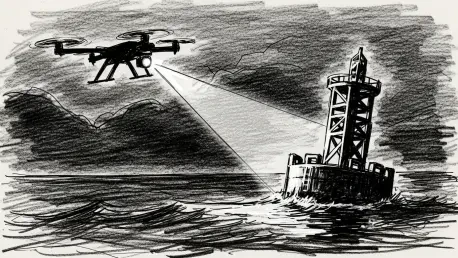

A solitary drone strike against a single mooring point in the Black Sea has triggered a seismic shift in Central Asia’s energy landscape, forcing a major oil producer to pivot its exports eastward overnight and revealing the profound fragility of the world’s interconnected energy supply chains. This single event raises a critical question for global markets: in an era of localized conflicts with global reach, how resilient are the arteries that carry the lifeblood of the modern economy? The answer, as demonstrated by Kazakhstan, lies in a rapid and decisive redrawing of the energy map.
When 1% of the Worlds Oil Supply Hangs by a Thread
The central challenge stems from an acute dependency on a single chokepoint. The Caspian Pipeline Consortium (CPC) route, which terminates at the Russian port of Novorossiysk, has long been the primary conduit for Kazakh crude, handling an astonishing 80% of the nation’s total oil exports. When a Ukrainian drone attack in November damaged a critical single-point mooring system at the terminal, it didn’t just disrupt a regional pipeline; it effectively throttled a flow of energy equivalent to 1% of the entire daily global oil supply.
This incident laid bare the outsized impact that a localized, tactical strike can have on global energy stability. The stakes are immense, as the disruption immediately threatened to strand millions of barrels of crude from one of the world’s most significant oil fields, Kashagan. The event served as a stark reminder that even with vast reserves, a nation’s economic security is only as strong as its most vulnerable export link.
The Caspian Corridor an Energy Artery Under Strain
For decades, the CPC pipeline has served as a vital East-West energy corridor, connecting the landlocked, resource-rich fields of Kazakhstan with international markets via the Black Sea. It represents a monumental feat of engineering and international cooperation, allowing Central Asian oil to reach refineries and consumers in Europe and beyond. Its consistent operation has been a cornerstone of Kazakhstan’s economic strategy and a stabilizing factor in global energy pricing.
However, the pipeline’s geopolitical route has always been its Achilles’ heel. By transiting through Russian territory to reach its export terminal, the CPC is inherently exposed to the geopolitical fallout from the conflict in Ukraine. The recent attack transformed this latent risk into an acute crisis, illustrating how critical infrastructure located within a conflict zone, regardless of its international importance, can become a target, sending immediate shockwaves through global energy markets.
From Black Sea to the Far East a Strategic Rerouting
In the wake of the attack on the Novorossiysk terminal, Kazakhstan initiated an unprecedented and rapid logistical pivot. Faced with a bottleneck in its primary western route, the country’s energy ministry authorized the first-ever shipment of crude from the supergiant Kashagan field directly to China. The state operator, Kaztransoil, confirmed a volume of 72,000 metric tons would be sent eastward through the Atasu-Alashankou pipeline, opening a significant new export front.
This eastward shift was part of a broader, multi-pronged strategy to ensure the continuity of its exports. In addition to the new China route, Kazakhstan bolstered flows through existing alternative pipelines, increasing volumes to the Atyrau-Samara pipeline toward Russia and the Baku-Tbilisi-Ceyhan pipeline, which bypasses Russia entirely. To manage the immediate backlog, Kaztransoil also offered temporary crude storage in its facilities, a critical measure to prevent production shut-ins while the logistical recalibration was underway.
A Consortium of Concerns the Global Reaction
The attack drew swift condemnation from both Astana and the Kremlin, who jointly emphasized the threat such actions pose to global energy security. Their shared concern highlights the complex web of interests tied to the pipeline’s operation. The CPC is not a solely Russian or Kazakh entity but an international consortium with major U.S. shareholders, including Chevron, underscoring the direct American economic stake in the pipeline’s security.
This network of international interests extends to the oil fields themselves. The Kashagan field, the source of the rerouted crude, is operated by a consortium of global energy giants from the United States, Europe, China, and Japan. Consequently, the disruption was not just a problem for Kazakhstan but a direct threat to the investments and supply chains of a host of the world’s largest economies, demonstrating how an attack on one piece of infrastructure can jeopardize a multitude of global economic and political interests.
A Blueprint for Resilience Navigating a New Era of Energy Risk
Kazakhstan’s response provided a real-world case study in energy security strategy for a new era of geopolitical risk. Its actions illustrate a clear framework for mitigating vulnerabilities in critical supply chains. The first pillar is proactive diversification, which involves actively developing and maintaining multiple export pathways to avoid over-reliance on any single route or political partner.
The second pillar is operational agility—the proven capacity to rapidly redirect massive volumes of product in response to an unforeseen crisis. Finally, the strategy rests on strategic diplomacy. By maintaining functional relationships with multiple global powers, including Russia, China, and the West, Kazakhstan ensured its logistical and political options remained open when its primary route was compromised. This multi-vectored approach appears to be the new standard for navigating an increasingly unpredictable energy landscape.
The events following the drone strike on the Novorossiysk terminal demonstrated a pivotal truth about modern energy security. It revealed that the stability of global oil flows depended not only on production capacity but on the resilience of the infrastructure that delivers it. Kazakhstan’s decisive pivot was not merely a reaction to a crisis; it was the execution of a strategy that prioritized diversification and agility, offering a tangible lesson for other nations navigating a world where energy infrastructure has become a frontline in geopolitical conflict.