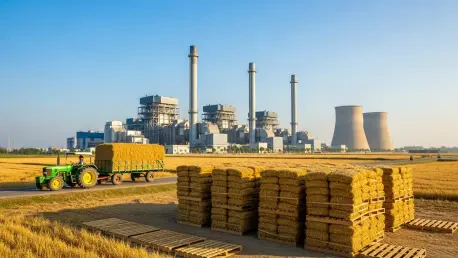

The dense, suffocating blanket of smog that traditionally paralyzed Northern India every winter is finally beginning to lift as industrial innovation meets agricultural necessity. In the heart of Punjab, Vedanta Power’s Talwandi Sabo Power Limited (TSPL) facility is spearheading a transformative initiative that turns the hazardous practice of stubble burning into a sustainable energy solution. By reimagining agricultural waste as a valuable resource rather than a seasonal nuisance, this project provides a blueprint for cleaning the air while powering the grid.
Integrating agricultural residues into the thermal power generation process addresses the root cause of regional air pollution. Instead of setting fire to leftover paddy straw, farmers now have a viable destination for their waste, which is processed into pellets and co-fired with coal. This strategic shift away from total coal reliance reflects a broader commitment to diversifying the fuel mix and stabilizing the energy sector against environmental volatility.
The Urgency of Sustainable Energy and Agricultural Waste Management
Paddy straw burning has long been a primary driver of deteriorating air quality, posing severe health risks to millions of residents in Northern India. The massive release of particulate matter during the harvest season creates an environmental crisis that transcends state borders, demanding more than just regulatory bans. By creating a circular economy, TSPL links the energy demands of heavy industry directly with the waste disposal needs of rural communities, turning a liability into an asset.
The relevance of this project extends beyond local air quality to international climate commitments. Meeting strict regulatory benchmarks for carbon reduction requires a departure from business-as-usual operations. This initiative demonstrates that industrial energy needs can be harmonized with environmental stewardship, providing a scalable model for meeting global decarbonization targets while supporting the livelihood of small-scale farmers.
Research Methodology, Findings, and Implications
Methodology
The study involved rigorous quantitative tracking of biomass co-firing rates at the Mansa facility to ensure compliance with emission standards. Analysts monitored the percentage of biomass integrated into the fuel mix, ensuring that the operational transition did not compromise the technical integrity of the boilers. These internal metrics were cross-referenced with external data points to validate the ecological impact.
Researchers utilized satellite monitoring and ground-level reporting to track the frequency of fire incidents across local villages. Furthermore, the analysis extended to the supply chain infrastructure, evaluating the efficiency of pellet manufacturing units and the effectiveness of farmer engagement protocols. This multi-layered approach provided a clear picture of how industrial logistics can suppress traditional burning practices.
Findings
The data revealed an impressive achievement: a 5.21 percent average co-firing rate, which successfully surpassed mandatory regulatory requirements. By processing 360,000 metric tonnes of biomass, the facility reduced carbon dioxide emissions by approximately 0.40 million tonnes. These figures highlight the immediate environmental dividends of substituting coal with carbon-neutral agricultural waste.
Socio-economic breakthroughs were equally significant, with stubble burning incidents in the surrounding region plummeting by 87 percent. Over 100 villages reported zero fire incidents, largely due to the active involvement of 3,800 local farmers who entered the formal supply chain. This shift not only cleared the skies but also injected new revenue streams into the rural economy.
Implications
The results validate biomass co-firing as a practical, large-scale alternative to field burning for modern thermal power plants. This “waste-to-wealth” model offers a theoretical and practical framework for stabilizing rural economies while simultaneously greening the energy sector. It proves that industrial synergy can effectively solve complex environmental problems without sacrificing energy reliability.
Beyond the numbers, the societal benefits include significantly improved public health outcomes resulting from reduced seasonal smog. By providing an economic incentive for environmental compliance, the project has fostered a more resilient relationship between the energy industry and agricultural stakeholders. This alignment is crucial for any long-term strategy aimed at sustainable regional development.
Reflection and Future Directions
Reflection
The operational success of establishing a 1,000-tonne daily pellet production capacity marks a milestone in industrial logistics. However, the project also highlighted persistent hurdles, such as the seasonal nature of paddy straw collection and the high costs associated with biomass processing. Maintaining a consistent supply chain requires constant coordination and significant capital investment to remain viable year-round.
Success was largely dependent on a collaborative effort between industrial giants and local communities. Without the trust of the farming population, the infrastructure would have remained underutilized. This experience underscored the fact that technological solutions must be accompanied by robust social engagement to achieve meaningful and lasting environmental change.
Future Directions
Upcoming investigations should focus on advanced boiler technologies that can accommodate higher percentages of biomass without losing efficiency. Increasing the co-firing threshold would further displace coal consumption and accelerate carbon reduction. Exploring new pre-treatment methods for agricultural waste could also lower operational expenditures and make the process more cost-effective for other plants.
Scaling the “Mansa Model” to other thermal stations remains a priority for regional energy policy. To bridge the gap in high processing costs, stakeholders must advocate for specialized subsidies and stronger policy frameworks. Expanding this initiative across the northern power corridor could potentially eliminate the seasonal smog crisis while securing a low-carbon future for the entire nation.
Advancing Industrial Synergy for Environmental Preservation
Vedanta Power’s initiative successfully demonstrated that the intersection of industry and agriculture can yield profound environmental benefits. By transforming the agricultural landscape of Punjab, the project proved that large-scale power generation does not have to come at the expense of local air quality. The establishment of an integrated supply chain was the essential catalyst for this transition, ensuring that biomass became a reliable pillar of the regional energy strategy.
The shift toward a circular economy for agricultural waste offered a definitive solution to the problem of stubble burning while bolstering the rural economy. It became clear that long-term climate resilience depends on such innovative partnerships. Ultimately, the project contributed significantly to the broader mission of achieving a low-carbon energy future through practical, replicable industrial synergy.