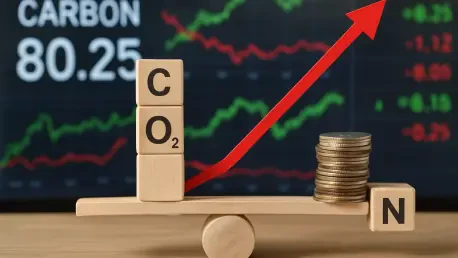

The European Union’s ambitious blueprint to price carbon emissions in almost every facet of daily existence has reached a critical juncture where the primary goal is no longer just cutting pollution, but preventing a widespread economic backlash. As the bloc prepares to launch the Emissions Trading System 2 (ETS2), policymakers are walking a tightrope between achieving aggressive climate targets and maintaining social stability. This transition represents a high-stakes gamble, where the rising costs of residential heating and road transport must be meticulously managed to avoid fracturing public support for the green agenda.
This analysis explores the technical evolution of the Market Stability Reserve (MSR), the widening political rift among member states, and the strategic mechanisms intended to keep carbon prices within a predictable range through 2030. By examining these factors, one can understand how the EU intends to de-risk its environmental strategy while shielding its most vulnerable citizens from the financial shocks of a decarbonizing economy.
The Mechanics of Stabilization and Market Adoption
Statistical Shifts: Strengthening Price Controls
The European Union has set an uncompromising target to slash emissions from the transport and building sectors by 42% by 2030, a goal that requires a fundamental restructuring of energy consumption. To facilitate this shift without causing market chaos, a price-regulation mechanism has been established to trigger automatic interventions if carbon costs breach the €45 per tonne threshold. This ceiling serves as a psychological and financial anchor, ensuring that the cost of compliance does not spiral out of control during the initial years of implementation.
Furthermore, the management of the Market Stability Reserve has been refined to provide long-term liquidity. By maintaining a strategic buffer of 600 million allowances, the EU can effectively dampen volatility. This inventory management strategy allows the market to absorb sudden shifts in demand while providing a clear signal to industrial players that the supply of credits will remain sufficient to prevent a total price collapse or an unsustainable spike.
Real-World Applications: The Safety Valve Mechanism
The EU has recently doubled its intervention capacity, granting authorities the power to release up to 80 million allowances annually to counteract aggressive price surges. This “safety valve” is designed to be highly responsive, acting as a technical corrective that stabilizes the market before inflationary pressures can trickle down to the consumer level. By increasing the volume of available credits in times of scarcity, the system maintains a steady upward trajectory for carbon pricing without the jagged peaks that disrupt business planning.
To complement these market maneuvers, financial shielding has become a priority through the European Investment Bank. A €3 billion frontload is being deployed to protect lower-income households from the rising costs of utility bills and fuel. This proactive funding is essential as the implementation of carbon taxes on road transport and residential heating moves toward its 2028 start date, ensuring that the transition remains equitable across different socioeconomic tiers.
Divergent Perspectives from Industry and Policy Leaders
The Stability Advocates: Market Credibility
Nations like Sweden and the Netherlands maintain that adhering to strict timelines is the only way to ensure the credibility of the EU’s climate policy. They argue that any delay in the expansion of carbon pricing would deter private sector investment and stall the development of clean technologies. For these advocates, a predictable regulatory environment is the ultimate tool for de-risking the transition, as it allows corporations to forecast their carbon liabilities with a high degree of certainty.
Social Impact Critics: The Green Inflation Fear
In contrast, countries such as Slovakia and the Czech Republic have raised alarms regarding the potential for “green inflation,” which could disproportionately affect regions with lower average incomes. These critics have pushed for a postponement of new taxes until 2030, fearing that a premature rollout could lead to social unrest similar to previous energy-related protests. They emphasize that the “social necessity” of affordable energy must not be sacrificed at the altar of environmental urgency, calling for a more gradual integration of carbon costs.
The Future Outlook for Carbon Pricing and Energy Affordability
Evolution of the MSR: Adapting to Net-Zero
As the bloc moves toward its 2050 net-zero objectives, the Market Stability Reserve is expected to undergo further iterations to handle a shrinking pool of total allowances. The “safety valve” will likely become more sophisticated, integrating real-time data to adjust supply in a manner that supports nascent industries like green hydrogen. This evolution will be a delicate balancing act, as the system must remain tight enough to drive innovation while staying flexible enough to prevent energy poverty.
Broader Consequences: A Global Blueprint
The success of this stabilization model could have far-reaching implications beyond the borders of Europe. If the EU proves that it can decouple economic growth from carbon emissions while keeping energy prices stable, its framework may serve as a blueprint for emerging carbon markets in Asia and the Americas. The final approval from the European Parliament will be the ultimate litmus test for this unified strategy, determining whether the world’s most sophisticated carbon market can truly harmonize environmental ambition with economic reality.
Summary and Final Reflections
The technical adjustments to the Market Stability Reserve and the extension of price-regulation mechanisms provided a necessary foundation for the next phase of European climate policy. By reinforcing the €45 threshold and increasing the allowance release capacity, the Council of the EU established a framework that prioritized market predictability over unchecked price discovery. These decisions reflected a sophisticated understanding of the need to protect the industrial base while simultaneously driving a shift in consumer behavior.
Moving forward, the focus must shift toward the rapid deployment of the Social Climate Fund to ensure that the 2028 launch of ETS2 does not widen the gap between wealthy and developing member states. Future policy reviews should consider more granular intervention triggers that account for regional energy mix differences rather than relying on a one-size-fits-all price ceiling. Ultimately, the durability of the EU’s carbon market depended on its ability to evolve from a purely environmental tool into a comprehensive socio-economic stabilizer.