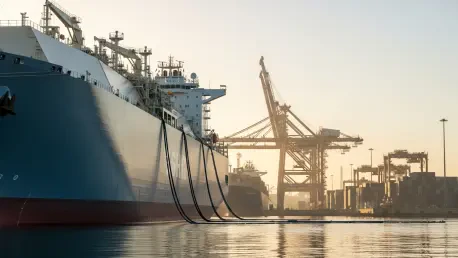

The global maritime industry, the lifeblood of international trade, is navigating its most significant transformation in a century as it confronts the urgent need to decarbonize, and a clear leader has emerged from the vast expanse of the world’s oceans. While the entire shipping world grapples with this monumental task, the containership sector has decisively taken the helm, establishing itself as the most advanced segment in the global shift toward alternative fuels. This is not a distant ambition but a present-day reality, underscored by compelling data from the global orderbook. An incredible 52.3% of new containership capacity, measured by gross tonnage, is already designed to operate on fuels other than conventional oil. By vessel count, this figure stands at a similarly impressive 46.8%, demonstrating a sector-wide commitment that is actively reshaping the future of shipping. This proactive stance signifies that container lines are not waiting for perfect solutions but are investing heavily in the available technologies to pioneer a cleaner, more sustainable era for maritime transport.
The Shifting Tides of Fuel Technology
The transition away from traditional bunker fuel is being led by a dual-fuel strategy, with Liquefied Natural Gas (LNG) currently reigning as the dominant alternative. LNG represents 36.1% of the alternative-fuel orderbook by gross tonnage, having become the standard choice for nearly all new ultra-large containerships. Its established infrastructure, relative to other green fuels, and its capacity to reduce emissions have made it the go-to foundational fuel for the initial phase of decarbonization. However, the market is witnessing a meteoric rise in the adoption of methanol, which is quickly becoming the secondary fuel of choice. The momentum behind methanol is undeniable, with orders skyrocketing from a mere 8 vessels in 2021 to 294 today. In a remarkable display of concentrated effort, the containership segment is responsible for an overwhelming 94% of the entire global methanol orderbook. Looking further ahead, the industry is also making early preparations for a zero-carbon future, with the first 23 ammonia-ready vessels now on order, indicating a long-term, multi-stage strategy.
The Practical Hurdles to Greener Seas
Despite the sector’s ambitious push, the path to decarbonization is fraught with significant operational and infrastructural challenges that cannot be overlooked. A primary trade-off for vessels designed to run on alternative fuels is a reduction in revenue-generating space, as these fuels require larger and more complex tank systems. This sacrifice in cargo capacity can be substantial, with losses estimated to be between 1,200 and 2,500 TEU per vessel, creating a direct impact on profitability. Furthermore, the market driving this change is highly concentrated, with just ten major liner companies controlling 92% of all alternative-fuel containerships on order. This raises questions about market access and the pace of adoption for smaller operators. Perhaps the most critical bottleneck, however, is the severely underdeveloped bunkering infrastructure. A staggering 78% of the current LNG-powered container fleet depends on a network of only 30 ports worldwide for refueling, while the availability of methanol is even more scarce, constraining operational flexibility and limiting green corridor routes.
A Future Forged in Commitment
The containership sector’s focused investment decisively moved the industry beyond theoretical planning and into tangible action. With more than half of all containerships scheduled for delivery between 2025 and 2028 being alternative-fuel capable, the segment positioned itself for a rapid and large-scale transition as soon as green fuels became more accessible. The strategic decision to build new vessels with enhanced fuel flexibility, making them both LNG-ready and methanol-ready, maximized operational optionality and de-risked long-term asset value in a volatile energy market. The explosive growth in methanol orders, in particular, demonstrated a proven market demand, confirming that cargo owners were increasingly willing to pay green premiums for sustainable shipping solutions. This alignment between carrier investment and customer demand created a powerful commercial incentive that cemented the containership segment’s role. The data affirmed that its commitment to driving the energy transition became an irreversible force, establishing a clear and determined trajectory for the future of maritime decarbonization.