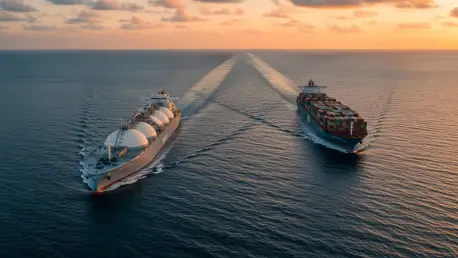

The global shipping industry is navigating the complex waters of environmental responsibility through a distinctly bifurcated strategy, creating a technological schism between the vessels of tomorrow and the vast fleet already at sea. A comprehensive analysis of fleet data from early 2026 reveals that the path to decarbonization is not a single, unified highway but two separate and parallel tracks. On one side, a new generation of ships is being constructed with alternative fuels at their core, representing a fundamental shift in maritime engineering and a long-term bet on a post-fossil fuel future. On the other, the immense existing fleet is pursuing a more immediate and pragmatic course, relying on retrofitted technologies to curb emissions and comply with increasingly stringent regulations. This dual-approach highlights a critical reality: while the industry’s future may be powered by LNG, methanol, and batteries, its present is overwhelmingly defined by the need to make legacy assets cleaner and more efficient. The divergence in these strategies underscores the sheer scale and complexity of transitioning one of the world’s most essential industries.
The Newbuild Frontier and Alternative Fuels
A Stark Generational Divide in Fleet Technology
The forward-looking vision for maritime shipping is most clearly seen in the order books for new vessels, where the commitment to alternative fuels is reshaping the future fleet’s composition. Data shows that vessels designed to run on alternative fuels constitute 26% of all new orders by vessel count and an even more substantial 47% by gross tonnage (GT), signaling that larger, more significant ships are leading this transition. This investment in new propulsion technology stands in stark contrast to the current active fleet, where such advanced vessels represent a mere 2% by count and 9% by GT. This significant gap illustrates that while shipowners are investing heavily in greener technology for their future assets, the overwhelming majority of ships currently transporting global goods remain dependent on conventional fuels. This generational divide presents a major long-term challenge, as the legacy fleet will continue to dominate the seas and its emissions profile for many years, making its own decarbonization journey just as critical as the innovation seen in newbuilds.
Dominance of LNG and Emerging Fuel Options
Among the array of alternative fuels, Liquefied Natural Gas (LNG) has firmly established itself as the dominant choice for the new generation of vessels, prized for its maturity as a technology and its immediate reduction in sulfur oxides, nitrogen oxides, and particulate matter. Following LNG, methanol is gaining significant traction as a viable clean fuel, with Liquefied Petroleum Gas (LPG) and advanced battery power systems also carving out niches within specific shipping segments. The industry’s confidence in these new energy sources is underpinned by a corresponding expansion of critical port infrastructure. Currently, LNG bunkering services are available at 222 ports worldwide, providing a growing network for these next-generation ships. Furthermore, shore power facilities, which allow vessels to turn off their engines while docked, are now present at 285 ports. While still in earlier stages, the availability of methanol bunkering is also expanding, reflecting the industry’s multi-fuel approach to a lower-carbon future and ensuring that these innovative vessels have the support they need to operate globally.
Upgrading the Legacy Fleet for Modern Compliance
The Pragmatic Path of Emission Control
For the tens of thousands of vessels that comprise the existing global fleet, a full transition to alternative fuels is often economically or technically unfeasible in the short term. Consequently, the primary strategy for this segment revolves around retrofitting technologies designed for immediate emissions control and enhanced efficiency. The most widely adopted of these solutions are exhaust gas cleaning systems, commonly known as scrubbers, which have been installed on 6,912 vessels. These ships represent a significant 31% of the global fleet’s total deadweight tonnage, demonstrating the technology’s central role in meeting sulfur emission regulations. Alongside scrubbers, systems aimed at reducing nitrogen oxides (NOx), such as selective catalytic reduction (SCR) or exhaust gas treatment systems, have been fitted to 5,563 vessels. This focus on after-treatment technologies highlights a compliance-driven approach, enabling older ships to continue operating within tightening environmental rules without undertaking the far more complex and costly process of engine replacement or fuel system conversion.
Exploring Advanced Retrofits and Infrastructure
Beyond the mainstream adoption of scrubbers and NOx reduction systems, a smaller but growing number of shipowners are investing in more advanced energy-saving technologies for their existing vessels. These emerging solutions point toward a deeper level of retrofitting focused on improving fundamental vessel efficiency. For instance, air lubrication systems, which reduce a ship’s hydrodynamic drag by creating a carpet of microbubbles under the hull, have been installed on 369 vessels. An even more cutting-edge technology, onboard carbon capture, is in its nascent stages, with installations confirmed on 58 vessels. While these numbers are modest, they represent a significant step toward tackling CO2 emissions directly from the existing fleet. It is important to note that these figures, based on declared equipment, are considered conservative. The actual adoption rates are likely higher, as the data does not capture the full pipeline of vessels awaiting retrofits, suggesting that the pace of technological upgrades across the legacy fleet is steadily accelerating behind the scenes.
A Divergent Voyage Toward a Greener Horizon
The maritime industry’s journey toward decarbonization ultimately unfolded along two distinct and parallel paths. The evidence clearly pointed to a strategic split, where the investment in newbuilds centered on a fundamental shift to alternative fuels, while the approach for the colossal existing fleet prioritized the immediate, compliance-driven benefits of retrofitted emission-control technologies. This dual-track strategy, born of economic pragmatism and technical realities, created a growing technological chasm between the advanced, cleaner vessels of the future and the legacy workhorses of global trade. The long-term success of the industry’s environmental goals hinged not only on the successful launch of these innovative new ships but, more critically, on the ability to bridge this gap. This required developing and scaling effective, affordable solutions that could elevate the performance of the thousands of vessels that would continue to form the backbone of the global supply chain for decades to come, ensuring the entire fleet could navigate toward a sustainable horizon.