
Christopher Hailstone has spent decades at the intersection of energy management and grid infrastructure, witnessing firsthand the shift from traditional power delivery to a complex, data-driven utility landscape. As a leading expert in grid reliability and security, he has become a vocal advocate for rethinking how we use the assets already in the ground. His recent work highlights a staggering inefficiency: much of the U.S. power grid sits idle for half of every hour, a wasted potential that could be the key to solving the modern affordability crisis. In this discussion, we explore the financial and operational mechanics of boosting system utilization, the rise of “managed loads” for data centers, and how regulatory frameworks must evolve to ensure that when utilities save money, customers actually see it on their bills.
Many power grids currently operate at roughly half-capacity during any given hour. How does boosting annual system utilization by 10% lead to lower customer rates, and what specific operational changes are required to move away from traditional infrastructure spending?
The fundamental math of utility rates is based on spreading fixed costs over the total volume of electricity sold. When we boost annual system utilization by 10%, we are essentially pushing more kilowatt-hours through the same wires and transformers that are already paid for, which can lead to an average 3.4% decline in customer rates by 2030. To achieve this, we have to move away from the “build-first” mentality where every new megawatt of demand is met with a new megawatt of generation and distribution infrastructure. Instead, operational changes must focus on load shifting, such as using smart electrical panels and HVAC load control systems to flatten the peaks that dictate system size. By integrating these technologies, a mid-sized utility can serve a massive influx of new load without the 1.4% rate hike typically seen in a “status quo” scenario. It is a transition from an expansion-based model to an optimization-based model, where the $140 billion in incremental annual revenue from new sales helps cover existing infrastructure costs rather than just funding new steel in the ground.
Data centers and advanced manufacturing are rapidly seeking new grid interconnections. How can utilities utilize distributed batteries and grid-enhancing technologies to find spare capacity, and what are the primary hurdles to deploying these tools at scale within the next five years?
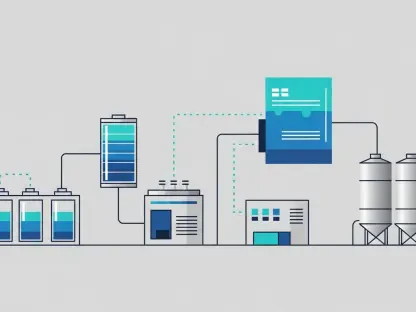
Utilities are sitting on a goldmine of latent capacity that can be unlocked using grid-enhancing technologies (GETs) and distributed energy resources like batteries, which have finally reached a level of maturity and affordability that makes them viable at scale. By deploying a portfolio of distributed batteries at a net cost of around $50 per kilowatt-year, we can create a “virtual” expansion of the grid that offsets the need for physical distribution upgrades. These batteries soak up power during low-demand periods and discharge it when data centers or manufacturers are hitting their peak, effectively smoothing the demand curve. However, the primary hurdle isn’t the technology itself—it’s the fact that many data centers are already snatching up the easy-to-reach “headroom” in the system, making the remaining capacity harder to find. Furthermore, our current regulatory structures often move slower than the five-year window these industries require, creating a bottleneck that technology alone cannot fix without policy support.
Some states have experienced nearly 40% load growth alongside falling utility rates, while others face sharp rate increases despite declining loads. What specific mechanisms allow high-growth regions to absorb demand without massive capital expenditures, and how can other regions replicate this inverse relationship between growth and cost?
We’ve seen remarkable examples in states like North Dakota, where a nearly 40% growth in load was accompanied by a 2.5% drop in rates, proving that growth doesn’t have to be a burden. This inverse relationship happens when high-growth regions successfully integrate new, large-scale industrial loads into existing infrastructure capacity rather than building entire new substations for every project. In contrast, states like California and Hawaii have seen rates soar while demand stays flat because they are stuck paying for aging or specialized infrastructure without the benefit of new sales to dilute those costs. To replicate the success of high-growth states, other regions must adopt “managed load” strategies where new customers agree to flexibility in exchange for quicker access. When you have more customers sharing the bill for the same grid, the individual cost for every homeowner and business naturally begins to trend downward.
Utilities often earn more revenue through traditional capital investments than through efficiency-focused utilization. How can regulatory models be restructured to align shareholder profit with cost-saving load flexibility, and what “shared savings” mechanisms would effectively balance these competing interests?
This is the central tension of the modern utility: under the current “status quo,” a utility might see its revenue jump 37% by simply building more traditional infrastructure, whereas an efficiency-focused approach might only see a 23% increase. To fix this, we need regulatory models that reward performance and cost-saving outcomes rather than just the total amount of money spent on capital projects. One effective “shared savings” mechanism would involve allowing utilities to earn a slightly higher return on equity—perhaps moving from 9.8% to 10.1%—if they meet specific targets for grid utilization and customer savings. By decoupling profits from pure infrastructure spend, we create a win-win scenario where the utility’s earnings go up because they are operating more intelligently, and customer rates go down because unnecessary construction is avoided. It’s about making sure the path of least resistance for a utility executive is also the most affordable path for the ratepayer.
AI data center customers often face interconnection delays of up to ten years. How does maximizing existing grid capacity reduce these wait times to under five years, and what role does managed load play in bypassing the need for immediate, large-scale generation build-outs?
The ten-year wait for AI data centers is largely driven by the time it takes to permit, site, and build new high-voltage transmission lines and large-scale power plants. By maximizing existing grid capacity through managed load programs, we can cut those interconnection timelines down to somewhere between one and five years. In this scenario, a data center might agree to “self-supply” power during the few hundred hours a year when the grid is most stressed or use sophisticated software to dial back non-essential processing during peak times. This flexibility allows the utility to connect the customer to the current system almost immediately, bypassing the decade-long slog of heavy construction. It’s a pragmatic trade-off: data centers get the power they need to compete in the AI race today, and the grid stays stable without forcing a massive, expensive generation build-out that would take years to complete.
What is your forecast for grid utilization?
I believe we are entering an era where grid utilization will become the primary metric of utility success, potentially saving customers between $110 billion and $170 billion over the next decade. As batteries continue to drop in price and load growth from EVs and data centers intensifies, the economic pressure to optimize our existing assets will become irresistible to regulators and utilities alike. My forecast is that by 2030, we will see a widespread shift toward “utilization-focused” planning, where earnings and affordability finally move in the same direction. For readers, my advice is to embrace the “prosumer” movement by adopting managed charging for your vehicles or smart HVAC systems; your individual participation in load flexibility is what will ultimately drive these system-wide savings and keep your energy bills manageable in an increasingly electrified world.