
As the backbone of global trade, the maritime shipping industry faces an immense and urgent challenge: charting a course away from its heavy reliance on fossil fuels toward a sustainable, net-zero future. With international regulations tightening and public pressure mounting, the search for viable green fuels has become the sector’s most critical pursuit. Amidst a sea of emerging technologies, Danish shipping giant Maersk is making significant waves by exploring a surprisingly familiar candidate. The company is actively testing ethanol, a widely produced biofuel, as a potential power source for its advanced dual-fuel vessels. This initiative, centered on its pioneering methanol-powered containership, represents a pragmatic and potentially game-changing move to diversify the industry’s low-emission energy options and accelerate its monumental transition toward decarbonization. The success of these trials could provide a scalable, readily available alternative to conventional marine fuels, offering a much-needed solution in the complex global energy puzzle.
Pioneering Trials on the High Seas
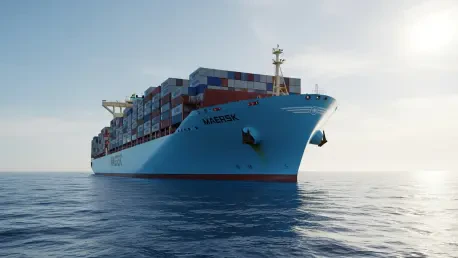
The centerpiece of this ambitious endeavor is the Laura Mærsk, the world’s first containership designed to run on green methanol. This vessel serves as a floating laboratory for a carefully phased testing process designed to validate ethanol’s performance and safety. The initiative began with a highly successful preliminary trial using an E10 blend, composed of 10% ethanol and 90% e-methanol. This initial phase confirmed that the mixture could be seamlessly integrated into the ship’s existing dual-fuel engine and fuel systems without requiring any significant modifications or compromising performance. Rigorous analysis during the trial verified that critical engine parameters—including ignition stability, combustion efficiency, material corrosiveness, and fuel lubricity—were all comparable to those of pure methanol. This crucial validation provided the necessary confidence and data to proceed, demonstrating that the two similar alcohol-based fuels could work in harmony within the sophisticated mechanics of a modern marine engine, a foundational step for any further exploration.
Buoyed by these promising initial findings, Maersk is now advancing to a more demanding phase of the program, escalating the experiment to an E50 blend containing a 50/50 mix of ethanol and methanol. This significant increase in the ethanol ratio will allow for a more thorough evaluation of the fuel’s long-term effects on engine components and overall operational efficiency under real-world maritime conditions. The ultimate objective of this methodical, step-by-step approach is to test the feasibility of running the vessel on 100% ethanol, a goal that could unlock a major new pathway for decarbonization. This phased strategy is critical, as it allows engineers to meticulously gather data, identify potential challenges, and fine-tune systems before committing to a full-scale transition. The chemical similarities between ethanol and methanol are the key enabler, suggesting that dual-fuel engines designed for one could, with proper validation, readily adapt to the other, dramatically expanding the portfolio of green fuels available to the global fleet.
The Strategic Appeal of a Familiar Biofuel
Maersk’s exploration into ethanol is not a random selection but a calculated decision rooted in pragmatism and scalability, addressing one of the biggest hurdles in the green energy transition: infrastructure. Unlike many nascent green fuels that would require the development of entirely new global production facilities and supply chains from the ground up, ethanol already boasts a mature and extensive market. As one of the world’s most produced biofuels, it has an established infrastructure for production, storage, and distribution, which could be leveraged to support the maritime sector relatively quickly. The United States and Brazil are the dominant forces in this market, together accounting for over 80% of global output, primarily from biomass sources such as corn and sugar cane. This existing industrial footprint means that ethanol offers a decarbonization pathway that could be scaled far more rapidly and with less initial capital investment than alternatives like green ammonia or hydrogen, making it a compelling tactical choice in the urgent race against climate change.
However, the viability of any biofuel hinges on its environmental credentials from production to consumption, a principle Maersk has placed at the core of its evaluation process. The company has emphasized that sustainability is a paramount and non-negotiable criterion for any fuel it adopts. To this end, a comprehensive lifecycle assessment is being conducted on all potential ethanol sources to ensure they meet stringent environmental and social standards. This rigorous vetting process scrutinizes the entire supply chain to guarantee full traceability and to confirm that the production of the biofuel does not lead to negative externalities. Specifically, Maersk is committed to sourcing ethanol that avoids contributing to deforestation, does not cause the conversion of natural lands for agricultural use, and does not create direct or indirect competition with global food supplies. This commitment ensures that the shift to ethanol genuinely reduces greenhouse gas emissions on a well-to-wake basis, solidifying its status as a truly “green” fuel solution.
Fueling a Net-Zero Future
These groundbreaking ethanol trials are an integral component of a far more comprehensive corporate vision aimed at positioning Maersk as a leader in maritime decarbonization. The company has set an aggressive goal to achieve net-zero greenhouse gas emissions across its entire business by 2040, a full decade ahead of the standard industry target set by the International Maritime Organization. To make this vision a reality, Maersk has established ambitious interim targets, including a commitment to transport at least 25% of its ocean cargo using green fuels by 2030. This strategy is backed by substantial investment in fleet modernization. Since the early 2020s, the company has exclusively ordered new vessels with dual-fuel capabilities, providing the flexibility to operate on green fuels as they become available. This forward-thinking procurement strategy is rapidly transforming its fleet, which is projected to include 19 dual-fuel vessels by the end of 2025, with an additional 24 on order for delivery through 2027, showcasing a tangible commitment to its long-term goals.
The successful integration of ethanol into the global shipping fuel matrix represented a pivotal development in the maritime industry’s complex and challenging journey toward sustainability. By validating a widely available and scalable biofuel, these pioneering efforts provided a crucial, practical option that expanded the portfolio of green energy sources beyond methanol and biodiesel. This diversification was essential, as it demonstrated that a multi-fuel strategy was not only viable but necessary to meet the varied operational demands of a global fleet. The trials conducted by Maersk moved the conversation from theoretical possibilities to tangible application, offering a clear and accelerated pathway for reducing emissions without waiting for entirely new infrastructures to be built. Ultimately, this exploration of ethanol underscored a broader industry shift toward pragmatic and adaptable solutions, which proved indispensable in the collective effort to achieve ambitious climate targets and forge a cleaner future for global trade.