
As nations worldwide pivot toward renewable energy, the inherent challenge of intermittency looms large over the stability of national power grids, and Belgium is addressing this critical issue head-on with a landmark project. A significant new contract has been awarded for the development of a massive 80 MW / 320 MWh Battery Energy Storage System (BESS) set to be built at the site of ENGIE’s Drogenbos power station near Brussels. This initiative, a collaboration between global energy company ENGIE and storage provider NHOA Energy, represents a crucial step in modernizing the country’s energy infrastructure. The project is poised to provide unprecedented flexibility to the Belgian grid, ensuring a reliable power supply even when the sun isn’t shining or the wind isn’t blowing, and setting a new benchmark for energy storage capacity in the region.
A Strategic Leap in Energy Storage
Project Scope and Impact
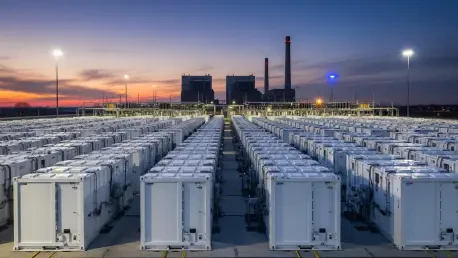
The technical specifications of the Drogenbos project underscore its ambitious scale and its potential to reshape local energy delivery. The BESS will be engineered using NHOA Energy’s proprietary NHEXUS platform, housed within a configuration of 88 specialized battery containers. This system is designed for a four-hour discharge duration, giving it the capacity to meet the average daily electricity consumption of more than 38,000 households. The project is on a clear development path, with construction scheduled to begin in March 2026 and full commissioning expected by September 2027. Upon completion, this mega-battery will not only serve as a powerful reserve of energy but also as a key asset in managing the complex dynamics of a modern grid that is increasingly reliant on variable renewable sources. Its ability to rapidly inject or absorb power will be instrumental in maintaining grid frequency and voltage stability.
Securing Grid Stability for the Future
The strategic importance of this energy storage system is officially recognized through its successful selection in Belgium’s fifth Capacity Remuneration Mechanism (CRM) auction. This achievement secures a 15-year operational contract for the facility, beginning in November 2027, guaranteeing its role as a long-term provider of critical services to the national grid. The CRM is designed to ensure the country has sufficient power generation and storage capacity to meet demand at all times, and the inclusion of the Drogenbos BESS highlights the growing consensus that large-scale batteries are indispensable for a resilient energy future. By providing essential flexibility and balancing services, the system will enable a greater share of wind and solar power to be integrated into the grid without compromising reliability, thereby accelerating Belgium’s transition away from fossil fuels and toward its clean energy goals.
Reinforcing a Key Partnership
A History of Successful Collaboration
This landmark project is not the first joint venture for ENGIE and NHOA Energy; rather, it marks the deepening of a long-standing and successful partnership. The collaboration traces its roots back to 2018 when the two companies commissioned a pilot battery storage system at the very same Drogenbos site, laying the groundwork for more ambitious undertakings. Building on that initial success, the partners are already engaged in the construction of the 400 MWh Kallo BESS, another significant project within Belgium. The decision to award NHOA Energy the contract for this new, even larger system is a clear vote of confidence, demonstrating ENGIE’s trust in its partner’s technology and execution capabilities. This progression from a pilot project to gigawatt-scale developments showcases a strategic alignment and a shared commitment to advancing energy storage as a cornerstone of the modern power grid.
Long-Term Service and a New Industry Standard
The announcement of the Drogenbos facility represented a pivotal moment, solidifying a new paradigm for critical energy infrastructure where long-term performance is as crucial as initial installation. Following the commissioning, the plant was set to be supported by a comprehensive Long-Term Service Agreement with NHOA Energy, a pact designed to guarantee high availability and optimized performance throughout its operational life. This agreement established a framework for continuous monitoring and data-driven maintenance, all backed by long-term warranties and leveraging a dedicated local service structure. This lifecycle approach reflected a broader industry trend, positioning large-scale battery storage not merely as a piece of hardware but as a fully managed, resilient asset. Ultimately, the project underscored the consensus that such mega-batteries were no longer a niche technology but an essential component for balancing supply and demand in any grid aiming for high renewable penetration.