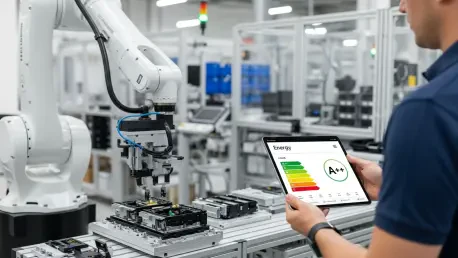

As global manufacturing floors hum with the activity of over four million industrial robots, a critical oversight in the push for sustainability has become increasingly apparent: the absence of a universal standard for measuring their energy consumption. While consumers can easily compare the efficiency of a new refrigerator or washing machine thanks to standardized energy rating labels, businesses looking to invest in robotic automation lack a similar tool, leaving them unable to make informed, environmentally conscious purchasing decisions. This information gap creates a significant barrier to transparency and hinders the broader adoption of more sustainable manufacturing solutions. In an era where corporate environmental responsibility is no longer optional but essential, the inability to accurately assess and compare the energy footprint of these powerful machines represents a major challenge for industries striving to align their operations with global climate goals. This lack of a benchmark effectively obscures a substantial portion of a factory’s carbon footprint.
Forging a New Path Toward Transparency
In response to this pressing industry need, ABB Robotics has taken a leading role in a global initiative designed to establish the first-ever standardized method for measuring the energy efficiency of industrial robots. The endeavor has been a collaborative one, bringing together a diverse group of experts from various robot manufacturers and research institutes spanning 11 different countries. Facilitated by the Swedish Institute for Standards (SIS), this international consortium has worked to develop a comprehensive proposal for a new International Organization for Standardization (ISO) technical specification. The goal of this specification is to create a clear, consistent, and universally applicable methodology that will allow for direct, apple-to-apples comparisons of robot energy performance. This framework is not merely a theoretical exercise; it is a meticulously crafted document intended to provide a practical tool for customers, enabling them to factor energy efficiency directly into their procurement processes and long-term operational strategies.
The urgency behind this initiative is underscored by the significant and growing environmental impact of automation. Internal studies conducted by ABB have revealed a crucial finding: over 70% of an industrial robot’s total carbon footprint is generated not during its manufacture or disposal, but by the electricity it consumes throughout its operational lifespan. This single statistic dramatically shifts the focus of sustainability efforts, highlighting that the most critical step toward greener robotic automation lies in improving in-use energy efficiency. As automation continues to expand into new sectors beyond traditional manufacturing, the cumulative energy demand of the global robot fleet is set to increase substantially. For companies committed to meeting ambitious sustainability targets, such as those outlined in the Paris Agreement, reducing the carbon footprint of their automated systems is paramount. A universal energy standard provides the foundational data needed to drive this change, promoting innovation among manufacturers and empowering users to minimize their environmental impact.
The Future of Sustainable Automation
The culmination of this international collaboration was the creation of a global specification, completed in August 2026, that fundamentally reshaped the landscape of industrial automation. The implementation of this ISO standard empowered customers by providing them with the transparent, reliable data they had long needed to evaluate and select robotic solutions based on energy performance. This newfound clarity fostered a more competitive market where efficiency became a key differentiator, encouraging manufacturers to innovate and design more sustainable products. The standard did more than just introduce a new metric; it supported the manufacturing industry’s broader transition toward more energy-efficient practices, making a tangible contribution to corporate sustainability goals worldwide. The initiative ultimately proved that through dedicated collaboration and a shared commitment to transparency, the robotics industry could successfully address its environmental responsibilities and pave the way for a more sustainable future in manufacturing.