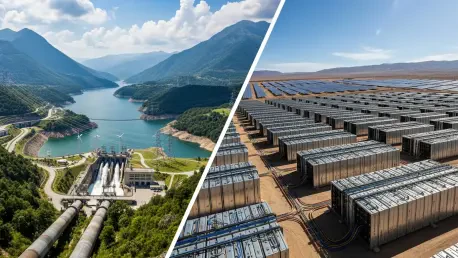

As renewable energy exceeds 40% of global electricity, the industry faces a key challenge: storing excess wind and solar power for when the grid needs it. Two technologies dominate large-scale storage: pumped storage hydropower (PSH) and battery energy storage systems (BESS), mainly lithium-ion. Both are proven at scale and attracting major investment. For developers, utilities, and investors, understanding each technology’s strengths and limitations is essential.
This is not a simple choice. Economics vary with project duration, grid services, regulations, and geography. What follows is a detailed assessment of both technologies on the factors that matter most.
The Scale of the Challenge
Grid-scale storage is essential for the clean energy transition. Pumped storage hydropower dominates the global installed base, with 179 GW in operation in 2023, representing most of the world’s stored energy. Battery storage is smaller but growing rapidly: the IEA reports annual battery additions now exceed pumped hydro, with deployment surging in the U.S., Europe, China, and Australia.
In the U.S., 55 PSH projects were proposed as of April 2024, totalling over 36 GW of potential capacity. Utility-scale battery storage has grown sevenfold since 2020. Both markets are expanding rapidly as renewable penetration increases and policy incentives accelerate deployment.
Key Metrics Compared
Dimension | Pumped Storage (PSH) | Battery Storage (BESS) |
Capital Cost (per kWh) | $1,500–$3,500 | $400–$600 (2024) |
Asset Lifetime | 50–100 years | 10–20 years |
Round-Trip Efficiency | 70–85% | 90–95% |
Response Time | Seconds to minutes | Milliseconds |
Optimal Duration | 8+ hours | 1–4 hours |
Development Timeline | 5–8+ years | 1–2 years |
Grid Inertia | Yes (synchronous) | Synthetic only |
Geographic Constraint | High (topography/water) | Low (flexible siting) |
Sources: BloombergNEF, DOE Grid Energy Storage Cost Assessment, EPRI.
Capital Costs Show a Genuine Gap
Battery storage currently holds a clear advantage on upfront capital costs. Lithium-ion battery pack prices fell to a record low of $115 per kWh in 2024, an 82% drop over the past decade, with utility-scale systems now costing $400–$600 per kWh, according to BloombergNEF. Pumped storage plants, by contrast, usually require $1,500–$3,500 per kWh due to the scale and complexity of the infrastructure.
For developers and financiers, capital cost per kWh is only one factor. The more relevant metric is the Levelised Cost of Storage (LCOS), which captures the full cost of storing and dispatching energy over an asset’s life. Here, the advantage shifts significantly to pumped hydro.
The Case for Pumped Hydro
A pumped storage plant is a century-class asset, with many installations lasting 50 to 100 years and modest maintenance costs once commissioned. The DOE’s 2024 Annual Technology Baseline highlights PSH’s long-duration advantage and ranks it among the technologies best positioned to reach the Storage Shot target of $0.05/kWh LCOS under advanced improvement scenarios.
Battery storage, by contrast, could require multiple full cell replacements over the life of a comparable PSH asset. NREL’s life cycle assessment of closed-loop PSH shows it has the lowest greenhouse gas intensity of any grid-scale storage technology, roughly a quarter that of compressed air storage, reinforcing its long-term sustainability in ESG-focused markets.
Operating Costs and Efficiency
Pumped hydro’s operating costs are low by nature: no fuel source, no electrochemical degradation, and a well-understood maintenance cycle tied to established hydropower engineering practices. Its round-trip efficiency typically runs at 70–85%, with newer variable-speed plant designs pushing toward the upper end of that range. Variable-speed PSH technology is now being deployed at scale in China and increasingly in European markets. It allows the pump to operate across a wider power range, dramatically improving grid service flexibility.
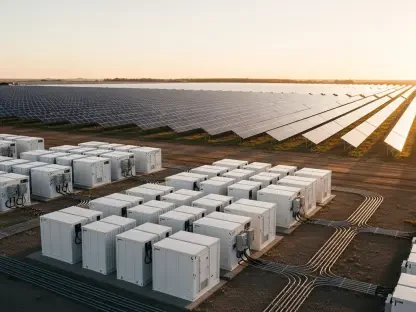
Battery storage achieves a higher round-trip efficiency of 90–95%, meaning less energy is lost in the storage and retrieval cycle. This efficiency advantage is operationally significant in markets where energy arbitrage drives the primary revenue stream. Battery systems also require no water and no specific topography, removing the geographic constraints that limit pumped hydro development.
Where Batteries Lead Decisively
For grid stabilisation, frequency regulation, and fast-ramping ancillary services, battery storage has a clear and largely unassailable advantage. Battery systems can respond to dispatch signals in milliseconds. In contrast, pumped hydro, even with modern variable-speed technology, operates on timescales of seconds to minutes. For grid operators needing fast frequency response within narrow regulatory windows, battery storage frequently represents the only technically viable option.
Grid-Scale Case Studies
The real-world track record of both technologies is instructive for practitioners evaluating project viability.
South Australia’s large-scale battery facility, now operating at 150 MW/194 MWh, was commissioned within months of contract award. It has become one of the most-cited demonstrations of battery storage providing fast frequency regulation on a high-renewable grid. Studies of its operation documented measurable reductions in frequency deviation events and significant annual grid service revenues, catalysing a global wave of similar deployments.
On the pumped hydro side, Snowy 2.0 in Australia is a 2,000 MW underground expansion of an existing scheme. It represents one of the largest energy storage projects currently under construction globally, with a storage capacity of up to 350,000 MWh. Its scale illustrates pumped hydro’s defining advantage: bulk, long-duration storage that battery systems cannot match economically over extended durations.
In the United States, the proposed Big Chino project (2,000 MW, closed-loop, outside Phoenix) and the San Vicente project (500 MW, outside San Diego) have been the subject of detailed DOE-commissioned modelling by GE. The analysis found that both projects would generate significant operating profits across a range of renewable buildout scenarios, with revenue split between energy markets and ancillary services. Crucially, the modelling reinforced that PSH value increases as renewable penetration rises, precisely the trajectory developers are betting on over 50-year asset lives.
In the UK, 2.5 GW of existing pumped storage provides approximately 26 GWh of balancing capacity, equivalent to powering around 3 million homes for a day. As the UK grid approaches its 2035 clean power target, developers are reassessing new PSH capacity, with growing interest in closed-loop and underground alternatives for post-industrial sites.
Emerging trend: Closed-loop pumped hydro sited in disused mine shafts and underground caverns is attracting developer interest globally, particularly in post-industrial regions where both the geology and the community economic case align.
Safety: Two Different Risk Profiles
Both technologies carry distinct safety profiles that developers, operators, insurers, and local authorities must understand and plan for. The differences are substantive.
Pumped storage hydropower’s principal risks relate to structural integrity, dam safety, water management, and civil engineering performance. These risks are governed by well-established regulatory frameworks built over decades of operating experience. The profile is well understood and manageable with standard engineering controls, supported by a long track record across diverse geographies. Closed-loop systems, which do not interact with natural waterways, carry a lower environmental risk profile than open-loop configurations.
Battery storage presents a different risk category. The central concern is thermal runaway, in which an individual battery cell overheats and triggers a self-accelerating chain reaction that can spread across an entire battery bank. Since 2021, EPRI has maintained a public BESS Failure Incident Database tracking large-scale battery failures globally dating back to 2011. Between 2018 and 2023, more than 60 utility-scale battery storage fires occurred worldwide, resulting in over 300 million dollars in damage and months of operational downtime.
High-profile incidents have shaped industry practice. A 2019 explosion at a BESS facility in Surprise, Arizona, injured four firefighters and triggered a fundamental reassessment of BESS safety standards in the U.S. market. A 2024 fire at the Gateway Energy Storage facility in San Diego burnt for seven days and required EPA environmental monitoring of battery disposal operations. In South Korea, 28 battery fires between 2017 and 2019 temporarily halted that country’s energy storage market during a period of rapid, under-regulated deployment.
The regulatory response has been substantial. NFPA 855 (2023 edition) introduced comprehensive requirements for BESS design, construction, commissioning, operation, and decommissioning. UL updated its UL 9540 and 9540A standards in 2025. Fire suppression system defects were identified in 26% of audited BESS sites in one industry survey, and thermal management defects in 18%. These figures underscore the importance of rigorous commissioning and ongoing maintenance protocols.
The industry is responding. Lithium Iron Phosphate (LFP) chemistry, now dominant in new utility-scale deployments, offers materially improved thermal stability compared to earlier NMC formulations. Advanced battery management systems, immersion cooling, and inter-module fire barriers are increasingly standard. Incident rates have declined since 2020 as standards have matured. But the risk remains real, and first responder preparedness, including awareness that lithium-ion battery fires cannot be extinguished with water and may reignite hours or days after initial suppression, remains an ongoing challenge.
For project developers: Early engagement with local fire authorities and adherence to NFPA 855 and UL 9540A are now baseline expectations for responsible BESS development. Mandatory site-specific hazard assessments and rigorous commissioning protocols are also considered essential, not optional enhancements.
Environmental Considerations
Neither technology is without environmental trade-offs, and both warrant scrutiny in ESG reporting and project appraisal. Large-scale open-loop pumped hydro requires significant land, water, and civil infrastructure. Reservoir construction can alter hydrology, disrupt ecosystems, and affect local communities, which contributes to long permitting timelines and tight geographic constraints. However, NREL’s life-cycle assessment found that closed-loop PSH ranks among the lowest greenhouse gas emitters of major grid-scale storage technologies, with brownfield siting reducing global warming potential by up to 20% compared to greenfield development.
Battery storage carries its own environmental burden. The extraction of lithium, cobalt, and nickel raises well-documented supply chain sustainability concerns. Battery waste management is an additional emerging challenge. As the first wave of utility-scale deployments reaches the end of life over the coming decade, the global waste stream will expand significantly. Without a robust recycling infrastructure, spent batteries risk becoming a material environmental liability. The commercial and regulatory response to end-of-life battery management will likely define the sector’s trajectory in the 2030s.
Complementarity, Not Competition
The framing of pumped storage versus battery storage as a binary competition misrepresents how the energy transition will actually unfold. The two technologies occupy different, largely complementary niches in the storage stack, and leading grid operators and developers are designing systems that deploy both.
Battery storage is better suited to short-duration, high-frequency applications such as frequency regulation, voltage support, demand charge management, and fast-response grid balancing. Its modularity allows rapid deployment almost anywhere without geographic constraint. For one to four-hour durations and millisecond response requirements, it is increasingly cost-competitive and continues to improve.
Pumped hydro is better suited to long-duration, high-volume energy shifting, balancing daily and seasonal renewable variation, providing bulk storage across extended periods, and delivering the synchronous inertia historically supplied by conventional generation. At durations above eight hours, its lifetime economics are typically superior, with advantages that widen as duration increases. Its century-scale asset life aligns with long-horizon investment frameworks.
For B2B energy professionals evaluating storage decisions, the message is straightforward: match the technology to the application. Short timelines and fast-response needs point to batteries. Long-duration storage and multi-decade grid support point to pumped hydro. Where applications span both, the optimal solution may be a deliberately integrated combination of the two.