
Listen to the Article
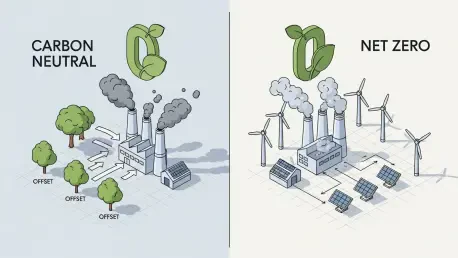
The market has moved past feel-good climate labels. Procurement teams now ask how much a supplier actually cut emissions, not how many credits were purchased. Regulators are closing the door on claims built on accounting tricks. The European Union (EU) has approved rules that restrict terms like carbon neutral or climate neutral when they rely on offsets alone, with enforcement beginning in 2026. The signal is clear. Net zero is an operating model. Carbon neutral is a disclosure choice. Only one change changes how a company produces, moves, and powers what it sells.
For energy and sustainability leaders, this is not semantics. It is capital allocation, supply chain pressure, and legal risk. Net zero forces structural cuts across Scope 1, Scope 2, and Scope 3 before any remaining emissions are neutralized with high-integrity removal. Carbon neutrality allows a company to pay for credits first and explain the rest later. That difference will separate resilient balance sheets from reputational liabilities over the next five years.
What Carbon Neutral Actually Means
Carbon neutral means the balance of a defined activity’s emissions is zero after reductions and the purchase of credits that claim to avoid or remove an equivalent amount of carbon dioxide. The definition often stops there. It rarely sets a minimum threshold for internal reductions. It often covers only carbon dioxide, ignoring other greenhouse gases with higher warming potential.
Standards have tried to impose order. The International Organization for Standardization (ISO) requires a hierarchy of quantify, reduce, then offset. In practice, the offset step can dominate if reduction targets are soft or optional. Credits can be purchased from projects that avoid new emissions, such as paying to prevent deforestation, or that claim to remove carbon, such as tree planting.
The trouble is verification and durability. Independent investigations and academic studies have shown wide variance in the integrity of avoided-deforestation credits, including cases where most issued credits did not reflect real-world emission reductions. Even when credits are legitimate, the company’s own emissions may not fall at all. That is why a carbon-neutral claim can sit next to a flat or rising absolute footprint.
What Net Zero Requires
Net zero sets a different bar. It covers all greenhouse gases, not just carbon dioxide. It requires deep, measurable cuts across the full value chain before any neutralization of residual emissions.
The Science Based Targets initiative defines a corporate net zero target as at least a 90% reduction in Scope 1, Scope 2, and Scope 3 emissions from a base year by 2050 or sooner. The final residual, up to 10%, must be neutralized by permanent removals. The SBTi Corporate Net-Zero Standard disallows the use of avoided-emissions credits in that final neutralization step. Only removal qualifies, and permanence must be measured in centuries, not seasons.
This is the crux. Net zero is not a procurement strategy for cheap credits. It is an operational and supply chain program that drives absolute emissions down to the lowest technically and economically feasible level. Credits are used at the end to deal with what cannot be eliminated today.
Why This Distinction Matters For Business
Three reasons make the distinction material for executives.
Regulatory exposure. The EU’s Empowering Consumers directive restricts green claims based on offsetting. Proposed Green Claims rules will require third-party verification of any environmental claim and clear disclosure of the role credits play. Similar scrutiny is rising in the United Kingdom and in U.S. enforcement actions.
Value chain pressure. Large buyers are passing Scope 3 requirements downstream. Many now score suppliers on disclosure quality, target ambition, and renewable energy sourcing. Failing that scorecard can mean lost tenders and shorter contracts.
Capital efficiency. Abatement embedded in processes, products, and power cuts operating costs over time. Credit purchases do not. When budgets tighten, the programs that survive are those that create efficiency or protect revenue.
Scopes, Boundaries, And The Real Work
Most corporate emissions sit outside the company’s walls. Scope 3 can represent 70 to 90% of a company’s total footprint in many sectors, including energy-intensive manufacturing and consumer goods. Any plan that ignores Scope 3 delivers an illusion of progress.
A net-zero operating model must address all scopes:
Scope 1. Direct emissions from owned assets. Typical levers include electrifying heat and transport, improving process efficiency, and switching to lower-carbon fuels where full electrification is not feasible.
Scope 2. Purchased electricity. The quality of renewable procurement matters. Short-term unbundled certificates do not equal decarbonized electricity in the company’s actual grid. High-impact power purchase agreements (PPAs), long-term bundled certificates, and 24/7 carbon-free energy contracts drive real grid impact.
Scope 3. Upstream and downstream emissions. This requires supplier engagement programs tied to purchase orders, product redesign to cut material intensity, logistics optimization, circularity, and changes in customer use-phase energy demand.
Offsetting, Credits, And Removals: What Still Works
Offsets are not binary good or bad. They are tools with very different degrees of integrity and impact. Two distinctions guide quality.
Avoidance vs removal. Avoidance projects prevent new emissions. Removal projects take carbon out of the atmosphere and store it. Net zero claims rely on removal for the residual slice only.
Durability and additionality. A credit must represent carbon that would not have been reduced without the project and must keep carbon out of the atmosphere for a long time. That is why tree-planting programs face scrutiny on permanence and why independent councils now set stricter labels for credits.
Market initiatives have raised the bar. The Integrity Council for the Voluntary Carbon Market (ICVCM) launched Core Carbon Principles to certify higher-integrity credits. The Voluntary Carbon Markets Integrity Initiative (VCMI) published a Claims Code to guide how companies communicate the use of credits. These frameworks do not replace internal reductions. They make the remaining credit use less risky and more credible.
Vignettes From The Front Line
Leaders show what credible removal can look like. Microsoft has publicly committed to becoming carbon negative by 2030 and has signed multi-year agreements for durable carbon removal across technologies like direct air capture and mineralization. It also reports lessons learned on project quality.
Frontier, a consortium led by Stripe, has pre-committed over one billion dollars to buy permanent carbon removal to help scale early technologies that meet strict additionality and durability screens. These programs sit on top of aggressive internal reductions and renewable energy procurement. The pattern is consistent. Cut first. Contract removal for what remains. Disclose everything.
Common Pitfalls To Avoid
Several recurring mistakes erode credibility and waste capital.
Treating offsets as permission to delay abatement. That approach will conflict with buyer scorecards and new disclosure rules.
Over-relying on unbundled renewable certificates. These improve market-based Scope 2 figures but may not change real-world grid emissions in the company’s operating regions.
Ignoring methane and nitrous oxide. Both are potent greenhouse gases. Programs that only count carbon dioxide miss large, cost-effective cuts in agriculture, waste, and oil and gas operations.
Making blanket product-level claims. Claims at a portfolio level can mask high-impact lines that remain far from targets. Precision beats generalization.
Minimize Your Emissions: Where To Start Now
Early momentum creates credibility and funds the harder work. Three moves pay off in most sectors.
Energy efficiency with metering. Tighten compressed air systems, heat recovery, building controls, and variable speed drives. Meter at the line and building level to verify savings and lock in gains.
High-impact renewables. Pursue long-term PPAs in grids where the additional capacity displaces fossil generation. Where 24/7 carbon-free energy contracts exist, pilot them for critical facilities.
Supplier activation. Focus first on the top 50 suppliers by emissions. Require disclosures, offer data tools, and co-invest in energy efficiency and renewables where payback is attractive.
A Clearer Standard For Claims
Language should follow outcomes. If a company is still early in reductions and relies mainly on offsets, the accurate claim is carbon neutral with transparent disclosure of credit type and volume. If a company has cut 90% of value chain emissions and neutralized the remainder with durable removals, the accurate claim is net zero under the SBTi standard. Mixing the two confuses buyers, invites legal scrutiny, and slows collective progress.
Closing Perspective
Net zero is demanding by design. It forces operational change, supplier engagement, and capital discipline. Carbon neutrality can be met with accounting. Over the next two years, regulation, buyer scorecards, and investor expectations will penalize the accounting route and reward the operators who cut first, then neutralize the true residual.
There is no pretending that this is easy or cheap. Some abatement requires process redesign, new equipment, or shifts in the supplier base. Durable removal remains scarce and expensive. Data quality is a grind. Yet companies that build a net-zero operating model tend to discover lower energy costs, tighter process control, better supplier performance, and stronger access to capital. The path is practical. Measure with rigor. Set targets that change decisions. Fund the cheapest tons first. Procure credible removals for what remains. Say exactly what was done and what comes next. That is how climate claims become business results rather than marketing copy.