
The global shipping industry, a colossal network responsible for transporting around 90% of world trade, has long faced the monumental challenge of reducing its heavy reliance on fossil fuels and its substantial carbon footprint. In a landmark achievement that harkens back to the age of sail with a distinctly modern twist, the cargo vessel Pyxis Ocean has successfully completed its maiden voyage, providing compelling evidence that a greener future for maritime transport may be closer than previously thought. This journey was not powered by unproven alternative fuels or massive battery arrays but by harnessing the oldest and most reliable source of power on the open ocean: the wind. The successful test signifies a potential paradigm shift, offering a practical and immediately applicable solution to an industry under immense pressure to decarbonize.
A New Era of Wind Propulsion
The Technology Behind the Sails
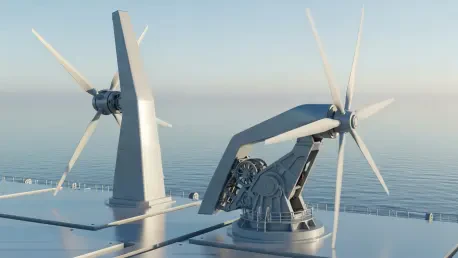
At the heart of the Pyxis Ocean’s success is a groundbreaking system known as WindWings, a technology developed by BAR Technologies that reimagines wind power for the 21st-century cargo ship. These are not the fabric sails of old but towering, 37.5-meter-tall solid wings, constructed from materials similar to those used in wind turbines, designed for maximum durability and aerodynamic efficiency. Installed on the deck of the Kamsarmax vessel, which was chartered by Cargill, the wings serve as a wind-assisted propulsion system. They are engineered to supplement, not replace, the ship’s main engine. The fully automated system uses wind sensors to constantly calculate the optimal angle for the wings to capture the most powerful gusts, deploying, retracting, and adjusting without manual intervention from the crew. All operations can be easily monitored and managed from the ship’s bridge, integrating seamlessly into the vessel’s existing operational workflow. This innovative approach allows the ship to reduce its engine’s power output, thereby conserving a significant amount of fuel and cutting down on harmful emissions while maintaining necessary speed and course.
Real-World Performance and Validation
The true measure of any new technology lies not in simulations but in its performance under real-world conditions, and the Pyxis Ocean’s initial voyage delivered quantifiable and impressive results. Throughout its journey, the vessel’s performance data was meticulously tracked, confirming the viability of the WindWings system as a powerful fuel-saving tool. On an average day at sea, the ship consumed approximately 3 tons less fuel than it would have without the wings, which translates to a daily reduction of nearly 10 tons of CO2 emissions. This consistent performance provides a strong business case for the technology’s adoption. Furthermore, the potential for even greater savings was demonstrated under more favorable wind conditions. John Cooper, the CEO of BAR Technologies, reported that during periods of near-optimal sailing, the daily fuel savings soared to an astonishing 11 tons. These figures are not just theoretical projections; they represent concrete evidence from a commercial voyage, validating years of research and development and establishing a new benchmark for wind-assisted propulsion in the modern shipping era.
Charting a Course for a Greener Fleet
The Economic and Environmental Imperative
The successful trial of the Pyxis Ocean comes at a critical juncture for the maritime sector, which is navigating the dual pressures of volatile fuel prices and increasingly stringent environmental regulations. The industry is tasked with achieving ambitious decarbonization targets, a goal that has spurred research into alternative fuels like ammonia and hydrogen, as well as battery-electric propulsion. However, these solutions face considerable infrastructure and technological hurdles and are likely years away from widespread, cost-effective implementation. The WindWings technology presents a compelling alternative by offering a tangible, here-and-now solution. Its most significant advantage is its capacity to be retrofitted onto existing vessels. With tens of thousands of cargo ships currently in operation globally, the ability to upgrade the current fleet is crucial for making meaningful environmental progress in the short to medium term. This retrofittable approach allows shipping companies to make immediate and substantial reductions in both their operational costs and their environmental impact without waiting for a complete fleet overhaul.
The Voyage’s Legacy and Future Horizons
The journey of the Pyxis Ocean did more than just test a new piece of hardware; it established a powerful proof of concept that resonated throughout the entire shipping industry. This single voyage successfully demonstrated that integrating ancient principles of wind power with modern aerodynamics and automation could yield significant economic and environmental benefits. It proved that wind-assisted propulsion was no longer a niche concept but a commercially viable and highly effective strategy for decarbonization. The data collected provided invaluable insights that will inform the next generation of vessel designs, potentially leading to ships built from the keel up to maximize the benefits of wind assistance. This successful trial shifted the conversation from what might be possible in the distant future to what is achievable today, catalyzing further investment and development in wind-propulsion technologies and marking a pivotal step toward a more sustainable and efficient era of global maritime transport.