
The sudden ousting of Venezuela’s government late last year by U.S.-led forces was a geopolitical bombshell that, against all expectations, landed with a surprising thud in the world’s energy markets. In a world conditioned to see oil prices surge at the first sign of instability in a major producing nation, the calm that followed the dramatic events in Caracas was deafening. This muted response raises a critical question: In an era of shifting supply dynamics, does the revival of a fallen petrostate still have the power to alter the global energy calculus, or has Venezuela’s moment passed? The answer reveals as much about the current state of the oil market as it does about the troubled nation itself.
The Paradox of a Quiet Crisis
Historically, a military intervention in a country boasting the world’s largest proven oil reserves would have sent shockwaves through trading floors, triggering a panic-driven price rally. Yet, the overthrow of the Maduro government in late 2025 barely registered. Instead of a dramatic spike, analysts projected a modest rise for Brent crude of just one to two dollars per barrel. This stability was not a sign of indifference but rather of a market that had already priced in the potential for disruption from a nation whose energy sector was a shadow of its former self.
The lack of a panicked reaction was largely due to market foresight. As Arne Lohmann Rasmussen, chief analyst at A/S Global Risk Management, noted, the possibility of a conflict disrupting Venezuela’s already meager exports was a known variable. While the scale of the intervention was unforeseen, the underlying risk was not, preventing the kind of knee-jerk price surge that defined previous geopolitical crises. The market’s calm demonstrated a new reality where the bark of geopolitical events in certain regions has become louder than their bite on global supply.
A Fall from Titan to Marginal Player
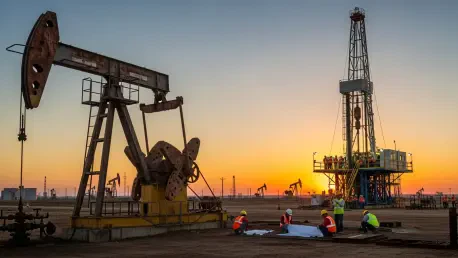
To understand the market’s composure, one must grasp the extent of Venezuela’s decline. At the time of the regime change, the nation’s oil production had collapsed to less than one million barrels per day (bpd), accounting for under 1% of global output. Its actual exports were even lower, hovering around 500,000 bpd. This dramatic downfall transformed a founding member of OPEC from an indispensable energy titan into a marginal player whose complete absence from the market would barely cause a ripple.
This internal collapse coincided with a period of external abundance. The global oil market in 2025 was well-supplied, cushioned by robust production from OPEC+ and a record output of over 13.8 million bpd from the United States. This supply glut had already driven the most significant annual price decline in five years, with Brent crude falling by approximately 19%. In this environment, the disruption of a small fraction of global supply from Venezuela was not a crisis but a minor variable in a market awash with oil.
Two Timelines for a Troubled Titan
The immediate aftermath of the coup poses no meaningful threat to market stability. According to Bob McNally of Rapidan Energy, even a complete halt of Venezuelan exports would not significantly impact global supply balances. The market remains focused on the bigger picture of macroeconomic health and demand trends, not the fate of a few hundred thousand barrels from a deeply troubled supplier.
However, the long-term horizon presents a stark dichotomy of immense potential and profound peril. The bullish case hinges on a new, stable government attracting the billions in foreign investment needed to rebuild its decrepit energy infrastructure. With U.S. sanctions lifted, some analysts, like Saul Kavonic of MST Financial, estimate that exports could eventually climb toward 3 million bpd. In contrast, the bearish case is grounded in a legacy of deep-seated political instability and financial distrust. The memory of asset expropriations in the 2000s and massive outstanding debts owed by the state oil company, PDVSA, create formidable hurdles for any international firm considering a return.
Expert Analysis on a Volatile Future
Expert consensus paints a picture of a long, arduous road ahead. David Goldwyn, a former State Department energy official, pointed to the “nowhere to go but up” potential for production but immediately tempered this optimism with a stark warning. Drawing parallels to the difficult transitions in Iraq and Afghanistan, he emphasized that establishing a stable governing structure capable of attracting and securing long-term investment is a monumental challenge. President Trump’s vague statement about the U.S. temporarily running the country “with a group” only amplified this uncertainty.
This skepticism is shared across the analytical community. While the potential for a production resurgence creates a fundamentally bearish outlook for long-term oil prices, the path to that reality is fraught with risk. The central question for international oil companies is not whether the oil is there, but whether the political and financial environment will ever be stable enough to justify the massive, decades-long commitment required to extract it.
Re-evaluating Risk in a Thirstier World
What makes the Venezuelan gamble suddenly compelling is a fundamental shift in the long-term outlook for global oil consumption. Until recently, the consensus held that demand would soon peak and decline, driven by aggressive climate policies and the rise of electric vehicles. In that scenario, a multi-billion-dollar project to revive Venezuelan oil would have been a poor strategic bet.
That forecast has since been revised. The weakening of climate policies in key consumer nations and a slowdown in EV adoption have pushed the timeline for peak oil demand further into the future. This new reality transforms Venezuela from a bad bet into a “tantalizing” prospect. The challenge of accessing the world’s largest reserves now appears more strategically attractive in a world that will remain thirsty for oil for decades to come, forcing companies to weigh the immense operational and political risks against a potentially enormous reward.
The overthrow of the Maduro government in 2025 ultimately served as a litmus test for the modern energy landscape. It revealed a global market insulated by diversified supply and a petrostate so broken that its political implosion barely registered as a supply-side event. Looking back, it was clear that the immediate market stability masked a far more complex long-term equation. The events demonstrated that unlocking Venezuela’s vast potential required more than just political change; it demanded a new framework for rebuilding international trust and a clear-eyed assessment of risk versus reward in a world that proved thirstier for oil than many had previously imagined.