
The global oil market has been thrust into a period of significant volatility, with West Texas Intermediate (WTI) crude prices plummeting to levels not witnessed since 2021, marking a stark reversal from previous highs. This dramatic downturn, which has pushed year-to-date losses beyond the 20% mark and dragged the international Brent benchmark below the critical $60 per barrel threshold, is not the result of a single event but rather a potent cocktail of bearish forces. A complex interplay of surging global supply, weakening demand signals, and shifting geopolitical landscapes has created a perfect storm for oil prices. Investors and market analysts are now grappling with the fundamental question of whether this is a temporary correction or the beginning of a sustained bear market. Understanding the multifaceted pressures at play is crucial for navigating the uncertain path ahead, as the delicate balance between production and consumption continues to be tested by macroeconomic headwinds and evolving international relations, painting a challenging picture for the energy sector.
The Supply and Demand Imbalance
A Flood of Production
A primary driver of the current price collapse is the relentless wave of supply overwhelming the market from multiple fronts, creating a persistent glut that shows no signs of abating. The OPEC+ alliance, which had previously curtailed output to stabilize prices, is now in the process of gradually restoring that idled capacity, systematically increasing the volume of oil flowing into the global system. This coordinated effort to bring production back online is being significantly amplified by the robust performance of non-OPEC producers. Chief among them are the United States and Brazil, where technological advancements and operational efficiencies have enabled a surge in output that continues to exceed market expectations. This dual-pronged increase from both traditional and emerging energy powerhouses has fundamentally altered the supply equation, ensuring that inventories remain well-stocked and placing consistent downward pressure on futures contracts as traders price in the reality of an oversupplied environment.
The supply surplus is further exacerbated by a notable de-escalation in geopolitical tensions, which is steadily eroding the risk premium that had previously supported higher oil prices. Recent and substantive progress in peace negotiations between Russia and Ukraine has been a pivotal development, signaling to the market a potential end to a conflict that had introduced significant uncertainty and volatility. More consequentially, these talks raise the distinct possibility of an easing or eventual lifting of sanctions imposed on Russian crude exports. Should this scenario materialize, it would unlock a substantial volume of oil that has been restricted from the mainstream market, releasing it into an already saturated global pool. The mere prospect of this additional supply has sent a bearish signal through the energy complex, as traders anticipate a future where Russian barrels compete more freely, intensifying the downward price pressure and compounding the challenges posed by the existing supply glut.
Faltering Global Consumption
On the other side of the market equation, the outlook for global oil demand is deteriorating rapidly, largely driven by concerning economic signals emanating from China, the world’s single largest oil importer. A recent cascade of economic data from the country painted a picture of broad-based weakness that has spooked commodity markets. Key performance indicators, including retail sales, industrial output, and fixed asset investment, all fell short of consensus expectations, revealing a significant slowdown in the engine of global growth. This economic deceleration has direct and immediate consequences for oil consumption forecasts. As industrial activity wanes and consumer spending contracts, China’s appetite for energy is expected to diminish accordingly. This downturn in demand from such a critical consumer has a powerful ripple effect, forcing analysts to revise global consumption models downward and reinforcing the bearish sentiment that has taken hold of the market.
While China’s economic struggles represent the most acute threat to oil demand, the malaise is not confined to a single nation; rather, it reflects a broader pattern of slowing economic momentum across several key regions. The combination of persistent inflation, rising interest rates in major economies, and lingering supply chain disruptions has created a challenging environment for global commerce and industrial production. These macroeconomic headwinds are curtailing business investment and dampening consumer confidence worldwide, leading to a more cautious approach to spending and travel. Consequently, the demand for transportation fuels like gasoline and jet fuel, which are significant components of total oil consumption, is facing downward revisions. This synchronized global slowdown creates a negative feedback loop, where weaker economic activity reduces energy demand, which in turn places further pressure on oil prices, contributing to the overarching narrative of a market struggling with both too much supply and too little consumption.
Technical Indicators and Market Sentiment
Charting the Downtrend
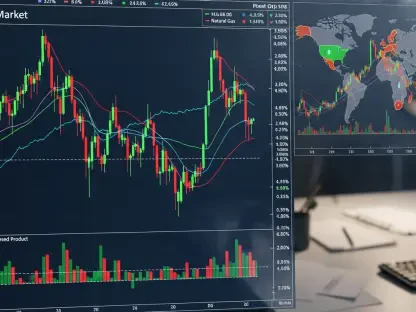
The fundamental bearish narrative is strongly corroborated by the technical picture, where price charts reveal a well-established and persistent downtrend for WTI crude. The commodity has been trading within the confines of a clearly defined descending channel, a classic technical pattern characterized by a series of lower highs and lower lows. This channel acts as a roadmap for the prevailing price action, with its upper boundary serving as resistance and its lower boundary as support, guiding the market steadily downward. Reinforcing this bearish structure are key momentum indicators, which are signaling continued weakness and a lack of buying pressure. These tools, used by traders to gauge the strength of a trend, are firmly in bearish territory, suggesting that the path of least resistance remains to the downside. The alignment of these technical signals with the negative fundamental backdrop has created a high-conviction environment for sellers, making any attempts at a sustained rally incredibly difficult to achieve.
Within this technical framework, specific price levels have emerged as critical battlegrounds for bulls and bears, with their defense or breach likely to determine the market’s next major move. A crucial support level has been identified near the $55.90 mark. This price point has served as a temporary floor, but a definitive and sustained break below it would be a significant bearish development. Such a breakdown would likely trigger a wave of automated sell orders and capitulation from remaining bulls, potentially accelerating the decline toward the next major psychological support zone around $52.00 per barrel. Conversely, for any bullish reversal to gain credibility, buyers would need to muster enough strength to overcome a formidable resistance area situated between $59.00 and $60.00. Reclaiming this zone would be the first step in challenging the downtrend, but until that happens, the technical outlook remains firmly in favor of lower prices, with the market poised for further losses should key support fail.
A Confluence of Pressures Redefined the Market
The precipitous fall in crude oil prices was ultimately the result of a powerful convergence of bearish factors that reshaped market dynamics. The simultaneous surge in global production, led by both OPEC+ and non-OPEC nations, created a supply glut that was compounded by the potential return of sanctioned Russian barrels. This oversupply met a demand landscape crippled by China’s pronounced economic slowdown and broader macroeconomic headwinds across the globe. The ensuing imbalance was confirmed and amplified by technical chart patterns, which established a clear downward trajectory and defined critical price thresholds that, once breached, accelerated the sell-off. This period demonstrated the market’s acute sensitivity to both fundamental supply-demand shifts and geopolitical de-escalation, reminding participants that sentiment can turn swiftly when multiple negative catalysts align. Looking back, the breakdown of key support levels served as a clear signal that the path of least resistance had shifted, leaving a lasting impact on investor confidence and setting a new, lower baseline for energy valuations.