
Sitting atop the planet’s most extensive proven oil reserves, Venezuela presents a stark contradiction: a nation of immense energy wealth crippled by an inability to harness it, setting the stage for a geopolitical shift that could reverberate through every corner of the global economy. The prospect of a new government in Caracas forces a critical question upon energy markets and foreign capitals alike: can the ghost of an oil giant be resurrected, and what chaos might ensue in the attempt? The answer lies not just in geology but in a complex web of corporate interests, decaying infrastructure, and the monumental task of rebuilding trust.
The Paradox of a Petro State on the Brink
The chasm between Venezuela’s potential and its reality is staggering. With reserves larger than Saudi Arabia’s, the nation should be a dominant force in global energy. Yet, its oil sector is a shadow of its former self. This discrepancy is the central tension in any discussion of its future. A political transition could unlock this immense potential, but the path from its current state of paralysis to becoming a reliable producer again is fraught with immense operational and financial hurdles that have been compounding for decades. Any change in leadership would not be a simple flick of a switch but the beginning of a long, arduous, and uncertain process.
The stakes are amplified by the strategic nature of Venezuelan crude. Its heavy, sour composition is a perfect, purpose-built feedstock for the complex and sophisticated refineries lining the U.S. Gulf Coast. These facilities were engineered to process this specific type of “gunky” oil, transforming it into high-value products like gasoline and diesel. The decline in Venezuelan exports forced these refineries into a costly search for alternative supplies. A restoration of this symbiotic energy relationship stands as a powerful economic incentive, promising renewed efficiency and stability for a critical component of the North American energy infrastructure.
The Ghost of an Oil Giant Why a Broken Industry Still Matters
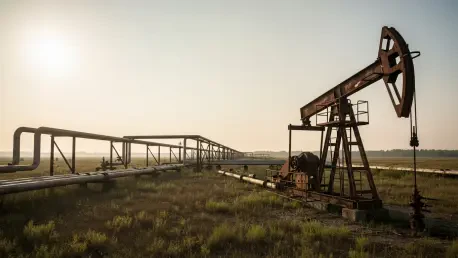
The story of Venezuela’s oil industry is one of catastrophic decline. Production has plummeted from a peak of roughly 3.5 million barrels per day (bpd) in the late 1990s to a current output of just 950,000 bpd, with only about 550,000 bpd reaching export markets. This collapse is a direct result of chronic underinvestment, mismanagement, and the systemic decay of everything from drilling equipment to pipelines under the state-run oil company, Petróleos de Venezuela (PDVSA). The physical infrastructure is in a severe state of disrepair, a testament to two decades of neglect that will not be easily reversed.
Control over this fractured industry remains firmly in the hands of the state. Despite the presence of international partners, PDVSA maintains a majority stake in all joint ventures, effectively dictating the terms of operation. Foreign companies, including American heavyweight Chevron and European firms Repsol and Eni, as well as Russian and Chinese state-owned enterprises, must navigate a landscape where the government holds ultimate authority. This state-centric model has historically prioritized political objectives over commercial efficiency, contributing significantly to the industry’s downward spiral.
The Scramble for Control Winners Losers and Market Chaos
In any post-Maduro scenario, analysts widely agree that Chevron is “best placed” to lead the charge. The company’s key advantage is its existing operational footprint and established infrastructure within Venezuela. This gives it an unparalleled head start over any potential newcomers, allowing it to scale up operations far more quickly than a company starting from scratch. European players like Spain’s Repsol and Italy’s Eni, which also have a presence in the country, are similarly positioned to benefit from a more stable and open investment climate, though Chevron’s deep-rooted presence likely puts it first in line.
The immediate market reaction to a sudden regime change is far from certain, with experts outlining two starkly different scenarios. One possibility is a period of “payment paralysis,” where a sudden political shift creates profound commercial uncertainty. With international buyers unsure of who holds the legitimate authority to receive payment, exports could grind to a complete, albeit temporary, halt. This supply disruption could introduce a significant risk premium to global crude prices, with one analyst suggesting it could add as much as $3 per barrel.
Conversely, a swift and peaceful transition could have the opposite effect. If a new, investment-friendly government is installed and U.S. sanctions are quickly eased, it could trigger a “sanctions relief fire sale.” Eager to generate immediate revenue, the new administration would likely push to sell off large volumes of crude held in storage. This sudden flood of oil onto the market could exert unexpected downward pressure on global prices, creating a short-term glut just as the world is bracing for a shortage.
A Chorus of Caution Expert Warnings on the Colossal Task Ahead
There is a resounding and unanimous consensus among industry experts: Venezuela’s oil sector is in a profound “state of disrepair.” This is not a matter of simple maintenance but of reversing two decades of systemic neglect that has hollowed out the industry’s technical capacity and ravaged its physical assets. The challenge is not merely to restart dormant oil fields but to rebuild an entire ecosystem, from the wellhead to the export terminals, a task of almost unimaginable scale and complexity that will test the resolve of any new government and its international partners.
The price tag for this revival is as colossal as the task itself. Estimates suggest that a sustained annual investment of at least $10 billion is required merely to begin the process of rehabilitating the decaying infrastructure and stabilizing production. This figure does not account for the capital needed to eventually expand output, but simply to stop the bleeding and lay the groundwork for a future recovery. Attracting that level of capital will require ironclad assurances and a stable political environment that has been absent for a generation.
However, some analysts caution against overstating the immediate global impact of a temporary Venezuelan outage. The global oil market is currently trending toward oversupply, which would act as a crucial shock absorber. Furthermore, Chevron’s ongoing licensed exports of around 150,000 bpd provide a baseline of stability. In this context, the temporary loss of the remaining exports might be less impactful than feared, with one expert describing the short-term market effect as “almost a nothing burger.”
A Blueprint for Revival The Perilous Path to Pumping Again
The absolute first prerequisite for any meaningful recovery is the establishment of a stable security environment. The cautionary tales of post-conflict Libya and Iraq loom large, where power vacuums and internal strife rendered vast oil reserves inaccessible and deterred the massive foreign investment needed for reconstruction. Without a secure and predictable landscape, international oil companies will not risk the billions of dollars required, and any blueprint for revival will remain purely theoretical.
Beyond physical security, a new government would face the monumental challenge of rebuilding investor trust. This would involve creating a transparent legal and regulatory framework that protects foreign capital, honors contracts, and ensures a fair return on investment. After years of nationalizations and arbitrary policy shifts, convincing global energy giants that Venezuela is once again a reliable place to do business will be a multi-year diplomatic and commercial effort, essential for attracting the sustained, long-term capital infusions the industry desperately needs.
Ultimately, any discussion of Venezuela’s oil revival must be grounded in a realistic timeline. Even under the most optimistic scenarios—a peaceful transition, immediate security, and a flood of foreign investment—a material increase in the nation’s oil production remains years away. The physical decay is too deep and the logistical challenges too vast for a quick fix. The world may be watching for a rapid change, but the reality on the ground dictates that the journey to reclaiming Venezuela’s status as an oil powerhouse will be a marathon, not a sprint.
The comprehensive analysis of Venezuela’s oil sector revealed a landscape defined by deep-seated challenges that overshadowed the immediate market volatility of any political transition. The expert consensus pointed not to a quick return to glory but to a long, capital-intensive, and perilous road to recovery. It became clear that the true story was not the short-term price fluctuations but the generational effort required to rebuild a shattered industry, an endeavor contingent on achieving a level of political stability and investor confidence that had long been absent.