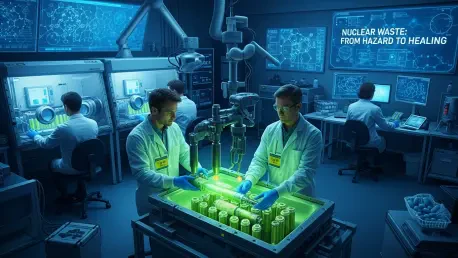

The persistent image of nuclear waste as a volatile, glowing green substance leaking from corroded barrels has long dominated public consciousness, fueling a deep-seated fear of the entire energy sector. This perception, largely shaped by early industrial accidents and Cold War anxieties, stands in stark contrast to the highly engineered, scientifically rigorous reality of modern nuclear material management. While historical events like the Windscale fire in the United Kingdom certainly highlighted initial gaps in understanding, they also served as critical catalysts for change. The subsequent establishment of international oversight bodies, such as the World Association of Nuclear Operators and the International Atomic Energy Agency, has since forged a global framework of unparalleled safety protocols. Today’s nuclear industry operates under a mandate of extreme caution and continuous improvement, making those early incidents poor benchmarks for evaluating the safety and potential of contemporary nuclear technology. The disconnect between public fear and scientific fact is not just a matter of semantics; it obstructs a crucial conversation about one of the most promising avenues for clean energy and, surprisingly, a source for revolutionary medical treatments.
Redefining Safety in the Nuclear Age
The evolution of nuclear safety protocols represents one of the most significant, yet underappreciated, stories in industrial history. Early incidents, while regrettable, provided invaluable lessons that directly led to the creation of a global safety culture that is now second to none. Following the Chernobyl disaster, the international community mobilized to ensure such an event would never happen again, giving rise to organizations like the World Association of Nuclear Operators (WANO). This body, alongside the International Atomic Energy Agency (IAEA), enforces rigorous peer-review processes and operational standards across the global fleet of nuclear reactors. This system of shared knowledge and mutual accountability ensures that a safety enhancement developed in one country is rapidly disseminated and implemented worldwide. Consequently, the operational and safety records of modern nuclear facilities bear little resemblance to their predecessors from over half a century ago. This commitment to proactive safety makes the industry a model of risk management, standing in stark contrast to the persistent and deadly externalities of other major energy sectors.
France offers a compelling real-world example of how a nation can safely and effectively build its energy infrastructure around nuclear power. With approximately 70% of its electricity generated by nuclear reactors, the country has mastered a sophisticated, multi-tiered approach to managing used nuclear fuel. The vast majority of this material is not high-level waste but can be reprocessed or requires minimal shielding. For the small fraction that is highly radioactive—about 2.5% of the total volume—France employs a process called vitrification. This technology involves melting the waste with glass to form a solid, stable, and leach-resistant material, which is then sealed inside robust stainless steel canisters. These canisters are placed within thick concrete dry casks, structures engineered to withstand extreme events. The U.S. Nuclear Regulatory Commission has calculated the annual fatality risk per cask to be an infinitesimally small 3.2×10^-14. This quantifiable safety record provides a sharp contrast to the estimated one in five global deaths attributed by a University College London study to the pervasive air pollution from burning fossil fuels, positioning nuclear energy as a demonstrably safer alternative for public health.
Unlocking a Hidden Medical Treasure
Beyond its role as a clean energy source, the byproducts of nuclear power are emerging as an indispensable resource for the medical field, fundamentally altering the calculus of “waste.” What was once viewed solely as a disposal liability is now being recognized as a repository of rare and life-saving materials. A pioneering initiative by the American company IsoTek has demonstrated this potential by successfully extracting thorium-229 from uranium-233 waste that had been stored for decades. Thorium-229 is the parent isotope of actinium-225, a critical component in targeted alpha therapy, a groundbreaking form of cancer treatment. This therapy uses alpha-emitting particles to destroy cancer cells with minimal damage to surrounding healthy tissue. By developing a method to harvest this vital material from existing nuclear byproducts, IsoTek has dramatically increased the world’s supply, promising to make these advanced medical treatments more accessible and affordable for patients globally. This transformation of waste into a medical asset underscores a paradigm shift in how we should evaluate the full life cycle of nuclear materials.
The successful extraction of medical isotopes from used nuclear fuel is not an isolated success but rather the beginning of a new chapter in the symbiosis of radiopharmaceuticals and clean energy. The process proves that the contents of spent fuel rods and other nuclear byproducts are not homogenous, useless materials but complex mixtures containing a variety of valuable, and often rare, elements. This realization opens the door for further research and development into “nuclear recycling” technologies that can separate and purify other medically and industrially significant isotopes. Such advancements could create a secure, domestic supply chain for materials essential for medical imaging, cancer therapies, and various industrial applications, reducing reliance on a handful of specialized research reactors worldwide. This approach reframes nuclear power plants not just as electricity generators but as dual-purpose facilities that produce both carbon-free energy and the foundational ingredients for a new generation of medical innovation, turning a perceived burden into a strategic national resource.
A Reconsidered Path Forward
The narrative surrounding nuclear energy has long been anchored in past events and outdated fears, which have obscured the profound advancements in safety and the emerging potential of its byproducts. The industry’s transformation, driven by rigorous international standards and innovative engineering, has established a safety record that far surpasses many conventional energy sources. Furthermore, the pioneering work in extracting critical medical isotopes from materials once labeled as “waste” demonstrates a paradigm shift. This has revealed a hidden value chain that directly contributes to human health, turning a perceived liability into a life-saving asset. The evidence presents a compelling case that skepticism toward nuclear power is rooted in a historical context that no longer reflects the current reality.