
Russian scientists have achieved a significant milestone in the global race for clean, limitless energy, successfully developing and testing a new high-temperature superconductor (HTSC) wire with record-breaking capabilities. This breakthrough, emerging from Rosatom’s DV Efremov Institute of Electrophysical Apparatus (NIIEFA), is a cornerstone for the Tokamak with Reactor Technologies (TRT) project—a next-generation fusion device intended to bridge the critical gap between today’s experimental reactors and the commercial power plants of tomorrow. This development is not merely an incremental improvement; it signals a fundamental strategic shift away from older, bulkier superconductor technologies toward a new generation of more compact, powerful, and economically viable fusion designs that could reshape the future energy landscape. The successful trial represents a pivotal moment, potentially accelerating the timeline for demonstrating practical fusion power.
A Leap in Superconductor Technology
The Record-Breaking Wire
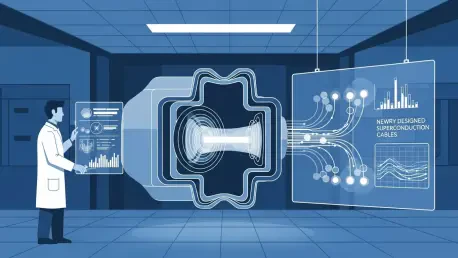
The centerpiece of this advancement is a five-meter sample of HTSC wire, an intricate piece of engineering designed to perform under some of the most extreme conditions conceivable. Its complex construction involves 240 individual high-temperature superconductor tapes that are meticulously embedded within a stabilizing copper matrix, which is then encased in a durable stainless steel sheath for protection and structural integrity. According to project leaders, this composite wire is engineered to handle an immense electrical current of 65 kiloamperes while being subjected to an exceptionally powerful magnetic field of 18 Tesla. These performance parameters are not just impressive; they establish a new benchmark in the field, as such a combination of high current and intense magnetic field has not been previously achieved in similar installations, pushing the boundaries of what is possible in magnetic confinement fusion.
This advanced wire is designed to operate in the extreme cold of cryogenic levels, a necessary condition for achieving superconductivity. To maintain these frigid temperatures, a specialized internal channel is integrated directly into the wire’s design, allowing for the continuous circulation of refrigerant at temperatures ranging from 5 to 20 Kelvin (equivalent to -450.67 to -423.67 degrees Fahrenheit). The recent successful tests were a crucial validation of this design. Using a dedicated measuring stand, scientists carefully monitored the wire’s electrical characteristics as it was cooled and entered a superconducting state under load. The positive results confirmed not only the wire’s structural integrity but also its ability to maintain its superconducting properties as designed, providing the essential proof-of-concept needed to move forward with scaling up the technology for the full-sized TRT reactor.
Smarter Faster Cheaper Development
A significant strategic advantage in the NIIEFA team’s approach lies in its innovative and pragmatic testing protocol. Instead of cooling the prototype wire all the way down to its ultimate operational temperature range near absolute zero, which would require expensive and complex liquid helium systems, the trials were conducted using liquid nitrogen. This brought the sample to a temperature of -320.8 degrees Fahrenheit (-196 degrees Celsius), which was sufficient for the high-temperature superconductor to enter its superconducting state and for researchers to verify its critical performance characteristics. This methodology represents a deliberate strategic choice designed to streamline the research and development process, overcoming some of the most significant logistical and financial hurdles that have traditionally slowed progress in the development of superconducting magnets for fusion energy.
This cost-effective testing approach yields substantial benefits that extend far beyond simple budget savings. Liquid nitrogen is far cheaper and significantly easier to handle and store than the liquid helium required for conventional low-temperature superconductors, drastically reducing the operational overhead for each experiment. Consequently, this allows for more frequent and rapid verification of new samples and design iterations, which in turn dramatically accelerates the entire development cycle. By enabling faster validation, this method brings the ultimate goal of an operational TRT tokamak much closer to reality. It allows engineers to identify and solve potential issues more quickly, refining the manufacturing process and building confidence in the technology before committing to the massive undertaking of producing the kilometers of wire needed for the final reactor.
Redefining the Standard
A Stark Contrast with ITER
The new HTSC technology developed for Russia’s TRT project stands in sharp and illuminating contrast to the materials being used in the International Thermonuclear Experimental Reactor (ITER), currently the world’s largest and most ambitious fusion experiment. The powerful magnets at the heart of the ITER tokamak rely on conventional low-temperature superconductors, specifically niobium-titanium and niobium-tin wires. These materials, while powerful, have a major constraint: they must be cooled to an incredibly frigid 4.5 Kelvin (-451.57 degrees Fahrenheit) to operate, necessitating a massive and complex cryogenic infrastructure. This reliance on established but demanding technology highlights a different philosophical approach to reactor design compared to the path being pursued by the TRT project, which bets on more advanced materials to unlock new possibilities in fusion reactor engineering.
In a clear departure from the ITER model, the TRT project utilizes advanced yttrium-barium copper oxide (YBCO) tapes for its superconductors. This represents a fundamental difference in material science that cascades into a host of design and performance advantages. High-temperature superconductors like YBCO can maintain their zero-resistance state at significantly warmer (though still cryogenic) temperatures, which simplifies the cooling requirements and reduces the associated energy costs and complexity. This choice is not merely an alternative but a technological generational leap. It reflects a strategic decision to leverage the latest advancements in materials science to create a fusion device that is not only powerful but also potentially more compact, efficient, and ultimately more economically practical than its predecessors, paving the way for next-generation fusion power plants.
Smaller and More Powerful
The practical advantages of the TRT’s HTSC wire become immediately apparent when comparing its physical dimensions and performance capabilities to those of its international counterpart. With a cross-section measuring just 26×26 millimeters, the Russian wire is substantially more compact and streamlined than the bulky 54×54 millimeter wires employed in the ITER project. This significant reduction in size is a critical engineering benefit, as it allows for a more compact overall reactor design. A smaller magnetic coil system can lead to a smaller tokamak, which in turn reduces the construction costs, material requirements, and the physical footprint of the entire power plant. This pursuit of a more elegant and efficient design is a central tenet of the TRT project’s strategy to develop a more economically competitive model for future fusion energy.
Remarkably, despite its significantly smaller size, the TRT wire is engineered for superior performance across key metrics. It is capable of operating in much stronger magnetic fields, up to 20 Tesla, compared to the 8 to 13 Tesla range of ITER’s magnets. A stronger magnetic field allows for better confinement of the superheated plasma, which is crucial for achieving a stable and sustained fusion reaction. Furthermore, the TRT wire can handle higher electrical currents, with a capacity of up to 80 kiloamperes, surpassing ITER’s maximum of 68 kiloamperes. This enhanced capability to carry more current in a smaller conductor demonstrates the profound impact of advanced materials on fusion technology, enabling the design of reactors that are not only smaller but also more powerful and efficient at their core function of containing a star on Earth.
A Calculated Path Forward
A Blueprint for a National Laboratory
The successful testing of the prototype wire set the TRT project on a clear and ambitious path toward full-scale construction. The project’s timeline included the manufacturing and testing of two much longer HTSC wires, each exceeding 60 meters in length, by 2026. This step was critical for scaling up the production process and ensuring quality control over longer segments. The culmination of these efforts was planned for 2027, with the creation of a full-scale mock-up of the central solenoid coil. This vital component, designed to be one meter in diameter and consisting of 40 turns of the HTSC wire laid in two layers, served as the definitive blueprint for manufacturing the kilometers of wire that would ultimately be required for the complete TRT reactor, validating both the material and the industrial processes needed for its construction.
The Future of Russian Fusion Research
The TRT reactor itself was slated for construction at the Troitsk Institute of Innovative & Thermonuclear Research (TRINITI), repurposing the site of the former TSP strong-field tokamak. The location’s existing infrastructure was undergoing significant upgrades to support the new, more advanced reactor. Once operational, the TRT was envisioned to function as a vital national laboratory. Its primary mission would be to conduct cutting-edge research into plasma behavior under conditions that closely mimic those of a commercial power reactor. Additionally, it would be instrumental in developing and refining the tritium fuel cycle technologies essential for future hybrid fusion-fission energy systems. This milestone, therefore, was not just a laboratory success but a key step in Russia’s strategic goal of advancing its domestic fusion energy program and securing a leadership position in the next generation of energy technology.