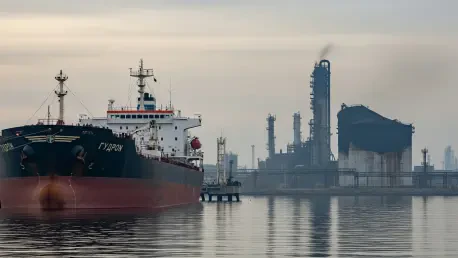

A cursory glance at Russia’s seaborne fuel export figures for November might suggest a month of relative stability, but this masks a dramatic and turbulent reality unfolding across its critical port infrastructure. While the nation’s total seaborne fuel exports experienced only a marginal decrease of 0.8% from the previous month, settling at 7.494 million metric tons, this near-stable aggregate figure conceals a profound internal reshuffling of logistical pathways. This period was defined by two powerful and opposing forces. On one hand, persistent and effective drone attacks on southern energy facilities created significant bottlenecks and operational halts. On the other, the timely completion of scheduled maintenance at several key northern refineries allowed for a surge in output that largely counteracted the southern losses. This dynamic interplay between disruption and recovery is not merely a short-term statistical anomaly; it represents a significant stress test of Russia’s export resilience and has catalyzed a tangible reconfiguration of its primary trade routes in the face of new security threats.
Southern Infrastructure Under Siege
The most severe impact of the ongoing conflict on Russia’s energy sector was felt along its southern export corridors, where shipments from Black Sea and Azov Sea ports experienced a precipitous decline. Exports from this strategically vital region plummeted by 30.2% to just 2.062 million tons, a direct consequence of targeted drone strikes on key infrastructure. The Black Sea port of Tuapse became a focal point of these attacks, suffering damage so significant that it forced a temporary but complete suspension of fuel export operations. The disruption cascaded through the local supply chain, as the attack also brought crude processing at the Tuapse refinery to a halt. Compounding the regional pressure, the major port of Novorossiysk was also targeted, further undermining the stability and reliability of the southern route. These incidents starkly exposed the vulnerability of maritime infrastructure in the region, creating a new layer of risk for an export system already navigating complex international sanctions and market pressures. The paralysis in the south forced a reassessment of logistical dependencies.
A Northern Counterbalance Emerges
In stark contrast to the disruptions paralyzing the south, a narrative of recovery and growth unfolded across Russia’s northern and eastern ports, effectively offsetting the Black Sea losses. Exports from the country’s Baltic ports—a network including Primorsk, Vysotsk, St. Petersburg, and Ust-Luga—surged by an impressive 20.6%, reaching a total of 4.697 million tons. This remarkable growth was primarily driven by the completion of extensive maintenance cycles at regional refineries, which brought previously offline capacity back into full operation. A pivotal element of this northern resurgence was the return to full capacity of Novatek’s gas condensate complex in Ust-Luga, which had finalized repairs from previous damage. This Baltic boom was complemented by significant upticks elsewhere; Arctic ports boosted their exports by a massive 80%, while even the distant Far East ports registered a modest 1.2% rise. This widespread increase demonstrated the system’s adaptive capacity, as logistical flows were rerouted to capitalize on operational northern hubs. The events of November ultimately showcased a forced but successful pivot, where the resilience of the northern and eastern export routes compensated for the acute vulnerabilities exposed in the south.