
While global headlines trumpet the daily fluctuations of West Texas Intermediate crude, the real story for Canada’s economic engine is quietly told in the price gap between its own heavy oil and this U.S. benchmark. This differential is not just an industry footnote; it is a critical economic indicator that directly dictates the financial health of the nation’s energy sector and ripples through the broader economy. For Canadian producers, investors, and policymakers, understanding this spread is paramount, as it holds the key to the true price Canada receives for its most valuable export.
Beyond the Headlines: Decoding Canada’s Two Tiered Oil Market
The global energy market speaks the language of benchmarks, with West Texas Intermediate (WTI) serving as the primary reference price for North America. Canadian producers use this U.S. light crude price to set their own pricing and to hedge against market volatility. However, the price they actually receive is for Western Canadian Select (WCS), a heavy crude blend that represents the bulk of Canada’s oil exports. This two-tiered system creates a complex dynamic where the headline WTI number tells only half the story.
The price of crude oil is a daily pulse check for the Canadian economy. It directly influences provincial government royalties, especially in Alberta, and determines the cash flow for a vast ecosystem of energy producers. Furthermore, its performance has a tangible effect on the value of the Canadian dollar and the momentum of the nation’s energy-heavy stock markets. The core thesis for any Canada-first market analysis is that the differential between WCS and WTI, not the absolute WTI price, is the most crucial metric. This price gap reflects the unique challenges and opportunities faced by key market players, from Albertan heavy oil producers to the specialized U.S. Gulf Coast refiners that are their primary customers.
Understanding the All Important Differential
The Great Discount: Why Canadian Crude Sells for Less
The persistent discount on Canadian crude is not arbitrary but is rooted in fundamental factors of quality and geography. WCS is a heavier, more sulfur-rich crude compared to the light, sweet profile of WTI. This means it requires more complex and costly processing to be refined into valuable end products like gasoline and diesel. Consequently, refiners are only willing to purchase it at a lower price to compensate for the additional operational expense, creating a natural quality-based discount.
Adding to the quality difference is a significant geographical disadvantage. Produced in the landlocked plains of Western Canada, WCS crude must travel vast distances to reach the major refining centers on the U.S. Gulf Coast, which are specifically configured to process heavy oil. This long journey incurs substantial transportation costs, further eroding the final price received by producers. These two factors—quality and location—establish the foundational discount for Canadian heavy oil relative to its U.S. counterpart.
Market forces then layer additional volatility onto this base discount, causing the spread to widen or narrow in response to changing conditions. A primary driver is pipeline capacity; when export pipelines are full, the competition for limited space intensifies, forcing producers to accept lower prices. Fluctuations in demand from U.S. refiners, who may switch to competing heavy crudes from other global suppliers, also directly impact the spread. Finally, broader global risk sentiment can influence refinery demand and transportation logistics, creating a dynamic and often unpredictable pricing environment for Canadian oil.
A Tale of Two Prices: Market Data and Recent Volatility
A snapshot of the market on February 8, 2026, illustrates this dynamic perfectly. While WTI held firm at $63.55 USD per barrel, the effective price for WCS was approximately $48.30 USD per barrel. This discrepancy is explained by the WCS discount, which settled at a significant $15.25 USD per barrel. For Canadian market watchers, this $15.25 figure is the day’s most important number, as it directly quantifies the financial impact of the sector’s unique challenges.
Recent price history reveals a choppy and uncertain market. WTI began the year with a spot price of $57.74 on January 8, before surging to $64.50 by the end of the month. This upward momentum quickly faded, with the price pulling back to $61.60 in early February before settling at its current level. This volatility demonstrates how quickly market sentiment can shift, reinforcing the need for producers to manage risk in a fluctuating environment.
This constant movement creates a “see-saw” effect on the margins of Canadian producers. A modest rise in the WTI price can be completely erased if the WCS discount widens simultaneously. Conversely, a day with flat WTI prices can be highly profitable for Canadian companies if the differential narrows, as it directly increases the revenue they receive for every barrel sold. This delicate balance means the industry’s profitability hinges just as much on managing the discount as it does on the global price of oil.
The Pipeline Predicament: Navigating Canada’s Logistical Hurdles
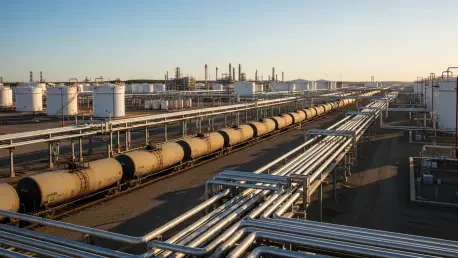
The primary challenge facing the Canadian oil industry, and a direct driver of the WCS-WTI spread, is a persistent bottleneck in transportation capacity. When the volume of oil produced exceeds the ability of pipelines to carry it to market, a backlog is created in Western Canada. This supply glut forces producers to compete for limited pipeline space, often by offering their crude at a steeper discount to entice buyers.
This logistical constraint is exacerbated by the economics of pipeline apportionment and alternative transport. Apportionment occurs when pipeline operators must ration space because nominations from shippers exceed the pipeline’s capacity. This forces some producers to either store their crude or seek more expensive transportation options, such as rail. While rail provides a flexible alternative, its higher per-barrel cost is directly reflected in a wider price differential, as the cost of transport is passed back to the producer in the form of a lower net price.
To navigate these hurdles, Canadian producers have developed several mitigation strategies. Many engage in sophisticated hedging programs to lock in a certain differential, protecting their cash flow from sudden price blowouts. Others focus on securing long-term, firm-service contracts on existing and future pipelines, ensuring they have guaranteed access to transport their product to market. These proactive measures are essential for maintaining financial stability in an industry defined by logistical constraints.
The Policy Pipeline: How Regulation Shapes the Spread
The regulatory landscape surrounding energy infrastructure plays a critical role in shaping the WCS discount over the long term. The approval, delay, or cancellation of major pipeline projects has a direct and lasting impact on transportation capacity. A predictable and efficient regulatory process can provide the certainty needed for companies to invest in the multi-billion-dollar infrastructure required to alleviate bottlenecks and narrow the spread.
Government policy, both in Canada and the United States, is a powerful lever that influences the flow of Canadian crude. Decisions made in Ottawa and Washington on cross-border pipelines, environmental assessments, and energy security can either facilitate market access or create new barriers. The political climate surrounding these projects is therefore a key variable that investors and producers must constantly monitor, as it can fundamentally alter the economics of Canadian oil exports.
Furthermore, environmental standards and inter-provincial relations add another layer of complexity. Disagreements between federal and provincial governments or evolving climate policies can create significant uncertainty for the sector. Achieving a stable and competitive price differential in the future will depend heavily on establishing a cohesive and supportive policy environment that enables the development of critical infrastructure while meeting modern environmental expectations.
Reading the Tea Leaves: Key Drivers Shaping the Future of the Spread
For market participants seeking to anticipate the future direction of the WCS-WTI spread, a handful of key indicators offer crucial insights. Beyond tracking headline prices, a deeper understanding requires monitoring the operational nuts and bolts of the industry. These practical drivers provide a more accurate forecast of whether the discount is likely to widen, creating headwinds, or narrow, providing a tailwind for Canadian producers.
Three factors are particularly critical to monitor. First is transportation scheduling and news related to pipeline capacity; any announcement of apportionment, maintenance, or progress on new projects will have an immediate market impact. Second is the demand for heavy oil from U.S. Gulf Coast refiners, whose purchasing patterns and utilization rates are a primary driver of WCS pricing. Third is the global supply of competing heavy crudes, as shifts in availability from other regions can reprice the entire heavy oil complex and affect the relative value of WCS.
Looking ahead, several potential market disruptors could significantly alter the current dynamic. Chief among them are new pipeline projects, such as the Trans Mountain Expansion, which promise to provide Canadian producers with much-needed access to new markets beyond the United States. The successful completion of such projects is widely anticipated to fundamentally tighten the WCS-WTI differential, allowing Canadian oil to fetch a higher price on the global stage and unlocking a new era of growth for the sector.
The Spread’s True Significance: A Barometer for Canada’s Economic Health
Ultimately, the analysis reinforced that the WCS-WTI spread is a far more precise barometer of the Canadian oil industry’s financial condition than the often-cited WTI price. This differential encapsulated the unique quality, geographical, and logistical challenges inherent to Canada’s energy sector. Its behavior directly dictated the realized prices and profit margins for producers, making it the central figure in the industry’s daily economic narrative.
The behavior of this critical price gap had a telling impact on broader Canadian economic indicators. A stable or narrowing differential often provided underlying support for the Canadian dollar and fueled positive sentiment in the TSX energy sector, attracting investment. Conversely, a widening spread acted as a significant headwind, creating negative pressure on the currency and investor confidence, even on days when global oil prices appeared stable. This connection underscored the spread’s importance beyond the oil patch.
The future prospects of the Canadian energy industry were found to be intrinsically linked to its ability to manage and narrow this price differential. Future investment, growth, and sustained profitability did not hinge on high global oil prices alone, but on the successful resolution of the transportation bottlenecks that created the discount in the first place. Therefore, Canada’s true oil story resided not in the global headlines, but in the nuanced and all-important spread.