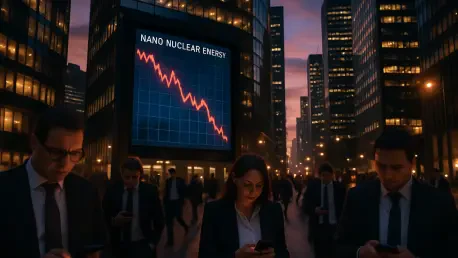

Imagine a company riding the crest of a technological wave, promising to power the future of AI and clean energy, only to see its stock plummet by over 30% in a single month. That’s the rollercoaster story of Nano Nuclear Energy Inc. (NASDANNE), a speculative player in the nuclear sector that has captured investor imagination with its microreactor technology. After skyrocketing nearly 700% since its 2024 initial public offering, the stock took a brutal hit in November, dropping from a 52-week high of $60.87 to $35.76 by early December. This sharp correction, mirroring a broader pullback in nuclear and AI-themed investments, has left the market buzzing with a critical question: is this a fleeting dip or a sign of deeper trouble? As the world hungers for sustainable power to fuel data centers and remote industries, NNE stands at a crossroads, balancing bold innovation against significant risks. Let’s dive into the dynamics of this volatile stock and explore whether it can stage a comeback.
This dramatic fall isn’t just a number on a chart; it’s a reflection of the high-stakes gamble investors are making on the so-called nuclear renaissance. NNE’s vision of compact, modular reactors to meet niche energy demands has fueled speculative fervor, yet the company remains pre-revenue with no regulatory approvals in hand. The November sell-off wasn’t sparked by a specific misstep from NNE but rather a market-wide rethink of overhyped sectors. With a current market cap of about $1.3 billion, the company’s future hinges on its ability to translate promise into progress. This article will unpack the layers of NNE’s situation—from stock volatility and business strategy to recent catalysts and looming challenges—to assess if this dip marks an opportunity or a warning.
Stock Performance and Market Dynamics
Unpacking the Dramatic Swings
The trajectory of NNE’s stock reads like a thriller, with dizzying highs followed by a gut-wrenching drop. Since its debut on the public market last year, the share price soared by an astonishing 700%, peaking at $60.87 within a 52-week range that also saw lows of $17.26. Yet, the mood shifted sharply in November, with a 31-36% decline that dragged the price down to $35.76 as of early December. This wasn’t an isolated stumble; it mirrored a broader retreat among speculative stocks tied to nuclear energy and AI infrastructure themes. Unlike traditional utility companies with steady earnings, NNE behaves more like a high-growth tech stock, where price swings are driven by sentiment rather than tangible results. The market’s enthusiasm for nuclear as a clean energy solution initially propelled NNE skyward, but the recent correction suggests investors are starting to question whether the hype matches reality. This volatility underscores a critical tension: can a company with no revenue yet command such a lofty valuation without eventually faltering under its own weight?
Moreover, the sector-wide pullback points to a cooling of speculative fever across similar stocks. Companies like Oklo and NuScale, also betting on innovative nuclear solutions, faced comparable declines, signaling that the market is reassessing the timeline and risks of these unproven technologies. For NNE, this means the November drop isn’t just a blip but a potential recalibration of expectations. Investors who jumped in during the peak may now be grappling with losses, while others might see the lower price as a chance to buy in. However, without concrete earnings or operational milestones to anchor its value, NNE’s stock remains a barometer of hope and doubt in equal measure. The question isn’t just about recovery but whether the market will continue to reward potential over performance in the near term. As sentiment shifts, the next moves for NNE will likely depend on its ability to deliver news that reignites confidence.
Sentiment Shifts and Broader Trends
Diving deeper into the forces behind this turbulence reveals a market caught between excitement and caution. The nuclear energy sector, often seen as a sleepy corner of utilities, has been thrust into the spotlight by growing demand for carbon-free power, especially for AI data centers that guzzle electricity. NNE rode this wave of optimism, with its stock becoming a darling of speculative investors chasing the next big thing. Yet, the November sell-off reflects a broader reality check, as the euphoria around AI and nuclear themes began to wane under scrutiny. Analysts note that many of these stocks, including NNE, trade at valuations disconnected from fundamentals—think price-to-book ratios as high as 6.8x compared to industry norms. This premium pricing leaves little room for error, and when sentiment turns, the fall can be steep. The recent downturn suggests investors are starting to prioritize proof over promises, a shift that could pressure NNE to show results sooner rather than later.
In contrast to the earlier frenzy, the current mood is one of guarded reassessment. Technical indicators for NNE show neutral short-term momentum, with support levels around $30 and resistance near $36-37, hinting at a stock searching for direction. Beyond the charts, the broader trend of nuclear energy as a solution for sustainable power remains intact, but the path is riddled with uncertainties. For every bullish argument about AI-driven demand, there’s a bearish counterpoint about long timelines to commercialization. This push and pull in market dynamics paints NNE as a high-stakes bet, where volatility isn’t just a feature—it’s the very nature of the game. As the dust settles from the recent correction, the focus shifts to whether NNE can leverage its position in this evolving landscape to restore investor trust, or if it will remain a victim of cyclical hype.
Business Model and Strategic Positioning
Innovative Technology and Target Markets
At the heart of NNE’s story lies a bold vision to revolutionize energy with microreactor technology, a concept that feels almost sci-fi in its promise. The company is developing compact, modular reactors like ZEUS, ODIN, and KRONOS MMR™, designed to deliver power in niche settings where traditional grids falter. Think AI and high-performance computing data centers in need of reliable, off-grid energy, or remote industrial sites and defense installations requiring resilient solutions. Unlike conventional nuclear giants focused on sprawling plants, NNE aims for flexibility—units that can be deployed quickly and scaled as needed. This positions the company at the intersection of clean energy and cutting-edge technology, tapping into urgent demands from sectors driving the digital economy. Yet, for all its forward-thinking appeal, NNE remains a speculative endeavor, with no operational reactors or regulatory green lights to back up its ambitious claims. The gap between vision and execution is wide, and bridging it will define whether this model is a game-changer or a mirage.
Adding to the intrigue is NNE’s push for a vertically integrated approach, which sets it apart from many peers. This strategy encompasses everything from fuel processing with high-assay low-enriched uranium (HALEU) to nuclear fuel transportation and consulting services. By controlling multiple facets of the supply chain, NNE seeks to create a seamless ecosystem for its microreactors, potentially lowering costs and boosting efficiency down the line. However, this comprehensive model also multiplies the challenges, as each segment requires expertise, investment, and regulatory approval. In a market hungry for sustainable power, NNE’s focus on niche applications like AI infrastructure in grid-stressed regions offers a compelling hook. Still, without a single unit in the field or revenue to show for it, the company’s strategic positioning feels more like a high-wire act than a proven path. Investors are left wondering if this intricate setup will be a strength or a stumbling block.
Early-Stage Risks and Speculative Nature
While the innovation behind NNE’s microreactors sparks excitement, the reality of its early-stage status tempers optimism with caution. The company is pre-revenue, meaning it has yet to generate a dime from its technologies, and none of its reactor designs have secured approval from the Nuclear Regulatory Commission (NRC). This isn’t a minor detail—it’s a fundamental barrier that could take years to overcome, given the notoriously stringent and slow-moving nature of nuclear regulation. Every step toward commercialization, from design certification to deployment, is laden with technical and bureaucratic hurdles. For a company banking on future demand, this prolonged timeline translates into sustained cash burn, estimated in the tens of millions annually, with no immediate payoff in sight. The speculative nature of NNE isn’t just a label; it’s a core characteristic that makes it akin to a venture capital play rather than a stable investment, testing the patience and risk tolerance of even the most optimistic shareholders.
Furthermore, the broader context of the nuclear industry adds layers of complexity to NNE’s journey. Established players with deeper pockets and government contracts, such as Constellation Energy or Holtec, already dominate parts of the landscape, often with proven technologies or faster paths to market. NNE’s bet on microreactors offers a point of differentiation, but it also means carving out a niche in a competitive field where failure to execute can be fatal. Add to this the market’s recent skepticism toward speculative stocks, as seen in the November downturn, and the pressure on NNE intensifies. The company’s $1.3 billion market cap prices in a future of significant success, yet the road to that future is paved with uncertainties. For now, NNE’s strategic vision remains a compelling story, but turning it into a sustainable business will require navigating risks that could easily derail even the most innovative ideas.
Recent Catalysts and Developments
Promising Partnerships and Projects
Amid the turbulence of its stock price, NNE has rolled out developments that hint at a brighter path ahead, even if they’re early steps rather than game-changers. A standout update came in late November with a feasibility study agreement alongside BaRupOn LLC for a potential 1-gigawatt nuclear energy project in Liberty, Texas. This initiative isn’t a construction contract—yet—but it targets high-demand areas like AI computing, robotics, and defense technologies, aligning perfectly with NNE’s niche focus. As a paid study, it signals interest from external partners and could lay the groundwork for future orders if successful. Such a project, if realized, would position NNE as a serious contender in addressing the power crunch faced by tech-heavy industries. While this news doesn’t erase the broader risks, it injects a dose of optimism into the narrative, offering investors something tangible to latch onto after the recent sell-off. The question remains whether this spark can ignite a sustained recovery or if it’s merely a fleeting distraction.
Beyond the Texas study, NNE has notched other wins that bolster its long-term outlook, though they come with caveats. Technical milestones, such as successful testing of the Annular Linear Induction Pump (ALIP) for extended microreactor operation, demonstrate progress in making its technology viable. Additionally, site-characterization drilling for a KRONOS prototype at the University of Illinois Urbana-Champaign marks a step toward real-world testing. These advancements are critical for proving the concept behind NNE’s reactors, yet they’re still far from commercialization or regulatory approval. Meanwhile, the company’s inclusion in Morgan Stanley’s National Security Index highlights its strategic relevance, particularly for defense applications. Together, these developments paint a picture of a company actively building momentum, but they also underscore how much further it has to go. Investors must weigh if these early successes are enough to counterbalance the speculative nature of the stock.
Strategic Expansions and Financial Footing
Another layer of NNE’s recent progress lies in its strategic expansions, which aim to broaden its footprint and credibility. The acquisition of Global First Power, now rebranded as True North Nuclear, enhances NNE’s presence in the Canadian market, a region with growing interest in nuclear solutions for remote and industrial needs. This move not only diversifies NNE’s geographic reach but also positions it to tap into potential government and corporate partnerships north of the border. Such expansions are smart plays for a company looking to establish itself as a global contender in the microreactor space, even if the immediate financial impact is negligible. However, integrating new operations and aligning them with NNE’s core vision will require time and resources, adding another dimension of execution risk. For now, this step signals ambition, but its true value will depend on how effectively NNE capitalizes on the opportunity.
On the financial front, NNE appears to have a buffer that many early-stage companies lack, which could be a lifeline amidst ongoing challenges. With an estimated $600 million in cash following a $400 million private placement, and a current ratio of roughly 73, the company boasts significant liquidity to fund research, development, and licensing efforts. This runway is a crucial asset, especially given the capital-intensive nature of nuclear innovation. Yet, there’s a flip side: repeated equity offerings to raise such funds have led to shareholder dilution, a sore point for existing investors watching their stakes shrink. While the cash position offers breathing room, the persistent burn rate and lack of revenue mean that financial strength is no substitute for operational progress. These recent catalysts and financial maneuvers provide a mixed bag—grounds for cautious hope, tempered by the reality that NNE’s recovery hinges on far more than just early wins or a healthy balance sheet.
Challenges and Risks
Sector Sentiment and Valuation Pressures
As NNE grapples with its post-sell-off reality, the reasons behind the November decline come into sharper focus, revealing a confluence of external and internal pressures. The sharp 31-36% drop wasn’t tied to a specific misstep by the company but rather a broader market shift, as speculative fervor around nuclear energy and AI-related stocks began to cool. Peers like Oklo and NuScale faced similar retreats, suggesting a collective reassessment of a sector once buoyed by unchecked optimism. For NNE, this meant a rapid unwinding of gains, as investors started questioning sky-high valuations unsupported by revenue or proven products. With a price-to-book ratio hovering around 6.8x—well above industry averages—the stock’s premium pricing became a lightning rod for criticism. This market sentiment shift isn’t just a temporary blip; it’s a signal that investors are growing wary of betting big on potential without performance. For NNE to rebound, it must confront the reality that hype alone can’t sustain its $1.3 billion market cap indefinitely.
Drilling deeper into the valuation concerns reveals a structural challenge that could haunt NNE for the foreseeable future. The company’s reliance on equity offerings to fund its capital-intensive journey, while necessary, has diluted shareholder value, eroding trust among some investors. Each new raise, like the recent $400 million placement, brings in vital cash but also spreads ownership thinner, leaving long-term holders frustrated. Meanwhile, the absence of near-term earnings keeps the stock vulnerable to further sentiment swings. If the market continues to pivot toward fundamentals over speculative growth, NNE could face sustained downward pressure unless it delivers concrete milestones. The November correction, in this light, isn’t just a reaction to sector trends but a warning about the fragility of a valuation built on future promises. Navigating this landscape will require more than just riding out the storm—it demands proof that the company’s worth matches its price tag.
Regulatory and Competitive Headwinds
Beyond market dynamics, NNE faces a gauntlet of operational and regulatory risks that could derail even the most optimistic recovery scenarios. Chief among these is the lack of Nuclear Regulatory Commission (NRC) approval for any of its reactor designs, a hurdle that looms large over the path to commercialization. Nuclear regulation is a slow, meticulous process, often spanning years, and there’s no guarantee that NNE’s innovative microreactors will clear the bar anytime soon. Without this critical green light, the company can’t deploy units or generate revenue, leaving it stuck in a prolonged pre-commercial phase. This timeline clash—between investor expectations for quick returns and the reality of regulatory delays—creates a persistent drag on confidence. Moreover, the high cash burn associated with R&D and licensing efforts only amplifies the stakes, as NNE must keep spending without a clear endpoint in sight. Until regulatory progress emerges, the risk of further sell-offs remains ever-present.
Compounding these challenges is the fierce competition within the nuclear energy arena, where NNE is far from the only player vying for dominance. Established firms with government backing, such as Constellation Energy or TVA, are securing large contracts and advancing projects with more immediate impact, often leveraging proven technologies. In contrast, NNE’s microreactor focus, while unique, pits it against both traditional giants and other innovators like NuScale, who are also chasing modular solutions. This crowded field means NNE must not only execute flawlessly but also differentiate itself in a market where trust and track record matter immensely. Add to this the potential for policy shifts or funding priorities to favor competitors, and the headwinds grow stronger. The combination of regulatory uncertainty and a competitive squeeze makes NNE’s road to recovery a daunting one, testing its ability to carve out a sustainable niche amidst giants and upstarts alike.
Investor Sentiment and Outlook
Polarized Views and Forecast Ranges
As NNE navigates the fallout from its recent stock plunge, the investment community remains deeply split on what lies ahead, reflecting the high uncertainty surrounding this speculative player. Analyst opinions paint a fragmented picture, with traditional Wall Street ratings oscillating between “Moderate Buy” and “Hold.” Price targets for the next 12 months span a wide gap—from a cautious $29.50, suggesting a 17% downside from the current $35.76, to an upbeat $51.00, hinting at a 40% upside. Algorithmic models add even more variance, with some projections reaching as high as $56, while others caution about further declines. This divergence isn’t just noise; it mirrors the fundamental tension between NNE’s transformative potential and its unproven track record. Technical analysis offers little clarity, showing neutral short-term momentum with no decisive buy or sell signals. For investors, this polarized sentiment means sifting through a maze of optimism and skepticism, where belief in the nuclear energy story often dictates one’s stance more than hard data.
Looking beyond the numbers, the split in forecasts reveals deeper truths about how NNE is perceived in the market. Bullish voices lean heavily on the exploding power demands from AI data centers, seeing NNE’s microreactors as a tailored solution for grid-constrained regions like Texas. They also point to strategic advantages, such as inclusion in national security indices, as evidence of broader relevance. Conversely, bearish perspectives hammer on the company’s pre-revenue status, regulatory limbo, and ongoing dilution from equity raises, arguing that the stock’s valuation leaves no margin for error. This tug-of-war in sentiment isn’t likely to resolve soon, as NNE’s trajectory depends on milestones that remain years away. For now, the wide range of predictions serves as a reminder that investing in NNE isn’t about consensus—it’s about appetite for risk and faith in a future that’s far from guaranteed. The market’s divided outlook keeps the stock in a state of flux, waiting for a catalyst to tip the balance.
High-Risk Strategy and Future Potential
Given the stark uncertainties, framing NNE as anything other than a high-risk, high-reward proposition would be misleading. This isn’t a stock for conservative portfolios or those seeking steady dividends; it’s a venture-style bet more suited to risk-tolerant investors comfortable with volatility. The post-November pullback might tempt some to view the current price as a bargain, but caution is paramount. Analysts suggest limiting exposure to a small portfolio allocation, ensuring that potential losses don’t sting too hard if things go south. The lack of near-term earnings or regulatory wins means that any investment in NNE is essentially a wager on its ability to execute over a long horizon. For those considering a position, the strategy should hinge on patience and a willingness to weather further swings, as the stock’s fate is tied to developments that could take years to unfold. This isn’t just about buying low; it’s about believing in a vision that’s still more concept than reality.
Despite the risks, the broader narrative around nuclear energy as a cornerstone of clean power keeps NNE’s story alive with potential. The relentless growth in electricity needs from AI and high-performance computing data centers offers a genuine market gap that microreactors could fill, especially in areas where traditional infrastructure can’t keep up. If NNE can navigate the regulatory maze and bring a product to market, it could ride this wave to significant gains. However, execution is everything—licensing delays, competitive pressures, and capital constraints could easily undermine even the most promising outlook. The nuclear renaissance is real, but not every player will emerge a winner. As NNE works to recover from its recent stumble, its future will depend on turning incremental progress into transformative results. Investors eyeing this space must decide if they’re ready to bet on a long shot with big dreams, knowing full well that the payoff, while enticing, is anything but certain.