
Beneath the surface of global commerce and beyond the reach of satellite surveillance, a clandestine armada of aging tankers plies the world’s oceans, forming the logistical backbone of a multi-billion-dollar illicit oil trade that directly challenges international law. While the world focuses on official sanctions, this ghost fleet, estimated at up to 1,400 vessels, masterfully evades detection to move sanctioned crude from Russia, Iran, and Venezuela, creating a shadow economy that reshapes energy markets and geopolitical alliances alike. This sprawling, decentralized network operates with impunity, raising a critical question: in an era of unprecedented technological monitoring, how does such a massive illicit operation continue to thrive, and can it ever truly be dismantled?
The New Great Game on the High Seas: Why the Shadow Fleet Matters
The rise of the shadow fleet has effectively fractured the global energy market, creating a bifurcated system where sanctioned oil trades at a steep discount compared to legitimate benchmarks like Brent crude. This two-tiered economy forces complex and inefficient rerouting of global energy flows. Russian oil that once traveled short distances to European refineries now embarks on long, costly voyages to reach buyers in Asia, increasing shipping costs and logistical complexities across the board. This disruption not only affects prices but also injects a new layer of risk and opacity into a market that relies on transparency and stability.
For nations like Russia and Iran, the revenue generated by this illicit trade is more than just profit; it is a strategic lifeline. These funds directly prop up their economies, enabling them to withstand the pressure of Western sanctions and continue pursuing geopolitical agendas that often run counter to the interests of the United States and its allies. The shadow fleet, therefore, is not merely a commercial enterprise but a crucial tool in a broader geopolitical conflict, allowing sanctioned states to maintain economic resilience and project power despite international isolation.
The entire operation hinges on the unyielding demand from energy-hungry nations, primarily China and India, which act as buyers of last resort. For these countries, the allure of heavily discounted crude outweighs the geopolitical risks. India’s imports last year accounted for a third of its total seaborne oil and a quarter of all of Russia’s seaborne exports, while China remains the principal consumer of both Russian and Iranian oil. This constant, high-volume demand provides the financial incentive that keeps the ghost fleet sailing and ensures a profitable market for sanctioned producers, undermining the very purpose of the sanctions regime.
Anatomy of a Ghost Fleet: How the Illicit Trade Works
The sheer scale of the shadow fleet is staggering, comprising a vast and highly adaptable network of over a thousand vessels operating in the gray zones of international maritime law. This is not a centralized command but a fragmented ecosystem of aging tankers, obscure ownership structures, and complicit service providers that can quickly reconfigure trade routes and tactics in response to enforcement pressure. Its decentralized nature makes it incredibly difficult to target, as shutting down one route or seizing one vessel does little to disrupt the overall flow of illicit oil.
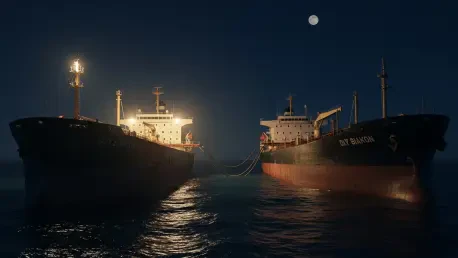
To evade capture, these vessels employ a sophisticated and constantly evolving playbook of deceptive tactics. A primary method is “going dark,” where a tanker disables its Automatic Identification System (AIS) beacon for extended periods, effectively vanishing from public monitoring systems while it conducts clandestine activities. Another common tactic is GPS “spoofing,” where a ship falsifies its location data to appear in a completely different part of the world. Perhaps most crucial is the use of clandestine ship-to-ship transfers, where oil is moved between tankers in remote offshore locations, often at night, to obscure its true origin before it reaches its final destination. Kpler data from last year revealed that 96% of vessels carrying Iranian oil conducted these “dark” transfers.
The resilience of this system is proven daily. Recent tracking data, for instance, identified several Russian-affiliated tankers, including the Giannis, Nyxora, and Tiburon, actively delivering sanctioned Urals crude to Indian refineries. These voyages, conducted in plain sight of monitoring services, serve as clear evidence that despite sanctions and increased scrutiny, the mechanics of the shadow trade remain robust and undeterred. The ability of these vessels to complete their journeys proves the fleet’s remarkable capacity to operate effectively against current enforcement measures.
Expert Takedown: The Economics and Adaptability Fueling the Fleet
At its core, the persistence of the shadow fleet is a simple matter of economics. As Kevin Book of ClearView Energy Partners notes, the steep discounts on sanctioned crude create an irresistible financial incentive, explaining that “barrels generally find a buyer.” For oil refiners operating on thin profit margins, the opportunity to purchase crude far below the market rate is often too attractive to pass up, ensuring that even the most politically toxic oil will “find a home.” This fundamental economic reality is the engine that powers the entire illicit trade, making it incredibly difficult to stop through policy alone.
The fleet’s operational strength lies in its fluid and fragmented nature. Analysts describe the force as “fungible,” capable of adapting swiftly to shifting geopolitical pressures. Tankers that once serviced the Venezuelan oil trade can be quickly reflagged and repurposed to move Russian or Iranian crude as enforcement priorities change. This adaptability makes the network a moving target. One analyst observes that as pressure mounts, the fleet simply becomes “more offshore, more fragmented, and more behaviorally extreme,” pushing its deceptive practices to new limits to stay one step ahead of authorities.
This dynamic is now playing out in a high-stakes geopolitical chess match centered on India, one of Russia’s most important customers. The recent announcement of a proposed U.S.-India trade deal, which reportedly includes a commitment from India to halt Russian oil purchases, has introduced significant uncertainty into the market. While Kremlin officials deny receiving any official notice and Indian leaders have remained publicly noncommittal, the mere possibility of losing such a critical buyer has sent ripples through the illicit oil trade, highlighting how diplomatic maneuvers could potentially achieve what direct enforcement has not.
The Global Crackdown: Strategies to Sink the Shadow Fleet
In response to the fleet’s brazen activities, Western nations are escalating their enforcement from policy to direct action. A recent coordinated EU-UK operation resulted in the French Navy intercepting the tanker Grinch off the coast of Marseille. The vessel was found to be transporting Russian oil under a fraudulent flag from the Comoros Islands, marking a significant victory for a more aggressive interdiction strategy. Similarly, the United States has taken direct action in the Atlantic, seizing the tanker Bella-1 for violating a complex web of sanctions related to Venezuelan, Russian, and Iranian oil, signaling a new willingness to use military and legal force on the high seas.
Beyond direct interdiction, the focus is shifting toward applying diplomatic and economic pressure on the key nodes of the network: the buyers. The potential U.S.-India trade deal represents the most significant attempt to disrupt the market by targeting a key customer. If successful, removing India from Russia’s list of buyers would not only cut off a massive revenue stream but could also give China, the other major purchaser, greater leverage to demand even steeper discounts. The ultimate survival of the shadow fleet may depend on China’s role, as its continued appetite for discounted crude remains the ultimate linchpin of the entire illicit system.
The future outlook depends on a delicate balance of risk and reward. The central question is whether increased enforcement can raise the costs and dangers of participating in the shadow trade to a prohibitive level. If the risks of seizure, fines, and legal action begin to outweigh the profits from discounted oil, the fleet could begin to shrink. Furthermore, if India does exit the market, it remains uncertain whether Russia can find enough new buyers to absorb the displaced barrels or if a significant portion of its shadow fleet will be forced into idleness, fundamentally altering the calculus of the illicit oil trade.
Conclusion: A Persistent and Unresolved Conflict
The global campaign against the shadow oil fleet has evolved into a protracted and complex struggle with no decisive victory in sight. The events of recent years have demonstrated that while Western nations possess the tools for more aggressive military and legal interdiction, the illicit network has proven remarkably resilient. It has adapted by becoming stealthier and more decentralized, fueled by the powerful economic incentives of discounted crude and the unwavering demand from key global markets. The seizures of vessels like the Grinch and Bella-1 represented tactical successes, yet the broader strategic challenge has remained.
Looking ahead, the conflict is poised to enter a new phase defined by economic diplomacy and the resolve of major energy consumers. The fate of the proposed U.S.-India trade deal could serve as a critical turning point, potentially reshaping energy flows and testing the limits of Russia’s ability to find alternative markets. Ultimately, the effectiveness of the global crackdown will not be measured by the number of ships seized, but by the ability to alter the fundamental economic equation that makes the shadow fleet profitable. Until the financial rewards are eclipsed by the risks, this clandestine armada was likely to continue sailing the world’s oceans, a persistent symbol of the unresolved tensions in global energy and politics.