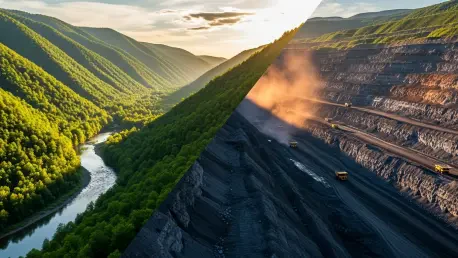

A democratic showdown is unfolding in Alberta, where the provincial government has taken the unprecedented step of altering legislation to retroactively nullify a citizen-led initiative aimed at halting new open-pit coal mining. This move has ignited a firestorm of controversy, with opponents decrying the action as a direct assault on the democratic process, designed to sideline public will in favor of industrial development in the ecologically sensitive eastern slopes of the Rocky Mountains. The conflict has pitted a broad coalition of ranchers, Indigenous groups, and environmental advocates against a government they accuse of changing the rules in the middle of the game. This legislative maneuver has not only stalled a significant grassroots movement but has also raised fundamental questions about the balance of power between citizens and their elected officials in the province, setting the stage for a prolonged and bitter dispute over the future of one of Canada’s most iconic landscapes.
A Democratic Process Derailed
The anti-coal petition, championed by Canadian country music artist and sixth-generation Albertan Corb Lund, had successfully cleared a major hurdle when it received formal approval from Elections Alberta in early December. This official endorsement was a pivotal moment for the movement, granting them the legal authority to commence the arduous task of gathering signatures from constituents across the province. The ultimate objective was to compel the United Conservative Party (UCP) government to introduce and pass a law that would permanently prohibit open-pit coal mining in the headwaters of the Rocky Mountains. The approval was celebrated as a victory for citizen engagement, signaling that the opponents of coal development had a legitimate, government-sanctioned path to make their voices heard and potentially enact lasting environmental protections through a process designed to empower ordinary citizens to directly influence legislation. The campaign was just beginning to mobilize its supporters when the political landscape shifted beneath their feet.
The momentum of the citizen-led initiative was brought to an abrupt halt just days after its official approval. In a swift legislative move, the UCP government passed Bill 14, a piece of legislation that specifically amended the rules governing the citizen initiative process itself. Following the passage of this new law, Corb Lund and his fellow organizers were formally notified that their previously validated petition was now void. The government’s justification was that the petition no longer complied with the newly enacted legislative framework. This action effectively reset the entire process, forcing the anti-coal advocates back to square one. They were informed they would need to resubmit their application under the new, and presumably more stringent, set of regulations. The retroactive application of the law was seen by opponents as a targeted measure to derail their specific effort, effectively invalidating a democratic process that was already officially underway and leaving many to question the government’s commitment to the very citizen initiative system it claimed to support.
A Vocal Opposition Fights Back
The government’s decision elicited a response of profound disappointment and legal bewilderment from the petition’s organizers. Corb Lund publicly questioned the legitimacy of an action that retroactively cancelled a process that had already received official sanction. He highlighted what he perceived as a significant act of bad faith by Alberta’s Premier, Danielle Smith. Lund recalled that only weeks earlier, upon learning of the petition’s approval, the Premier had declared herself a “great supporter of citizens’ initiatives” and had pledged to be “watching closely” as the process unfolded under the existing rules. The subsequent decision to “change the rules overnight” was condemned by Lund, who stated, “I’m amazed they could have this little shame.” He articulated a deep sense of disillusionment, noting that the sequence of events had severely damaged his trust in the political system and led him to declare that the government’s behavior had “made me lose my faith in what I thought was a democracy.” The move was framed not as a procedural update but as a deliberate political maneuver to silence a dissenting viewpoint.
Despite the significant setback, the movement’s leaders have vowed to persist in their campaign. Corb Lund took the opportunity to defend his coalition against what he described as baseless accusations, adamantly refuting claims that the opposition to coal mining is composed of “foreign-funded” activists or “environmental whack jobs.” He insisted that their support base consists of ordinary, working Albertans united by a singular, straightforward goal. “There’s no hidden agenda,” Lund clarified. “All we are trying to do as working Albertans is end coal mining in the headwaters. That’s all we are trying to do.” Demonstrating their resolve, the group immediately launched a website to recruit volunteers and announced their intention to resubmit the petition under the new, more challenging rules. This resilience signals that the government’s legislative action has not quelled the opposition but has instead fortified their determination to see the fight through, transforming a policy dispute into a broader battle over democratic principles and government accountability.
The Unacceptable Environmental Risk
The environmental stakes at the heart of this conflict are articulated in stark terms by experts with decades of experience in the region. Lorne Fitch, a retired provincial fish and wildlife biologist, described the eastern slopes of the Rockies as a vast and vital ecosystem. This area is not only home to threatened species such as grizzly bears and bull trout, but it critically contains the headwaters of major river systems, including the Old Man River. These headwaters provide the essential fresh water supply for a huge swath of the southern Canadian Prairies, sustaining communities and a robust agricultural industry that is a cornerstone of the regional economy. Fitch’s testimony underscores that the debate is about much more than a single industrial project; it concerns the long-term health and viability of the water source for an entire region. The potential for irreversible damage to this critical watershed forms the scientific foundation of the opposition’s argument, shifting the focus from economic benefits to the fundamental necessity of a clean and reliable water supply.
Drawing on an extensive career spanning over five decades dealing with coal exploration and reclamation, Lorne Fitch delivered a damning assessment of the industry’s environmental track record. He stated unequivocally that in his 50 years of observation, “not one coal mine ever successfully dealt with runoff.” This historical failure to manage water contamination, he argued, makes any new development an unacceptable risk. Fitch warned that “the costs of failure of a coal mine having significant or catastrophic problems is so awesome that we just cannot afford to have coal mining continue.” He emphasized that a clean and reliable water supply from the Old Man River watershed is indispensable for downstream drinkers, farmers, and the native trout fishery, which he called the “ultimate symbol for whether or not our land use practices are proper or not.” When asked for his final message to the government, Fitch’s response was blunt and succinct: “What part of no don’t you understand?” His perspective frames the issue not as a matter of improved regulation but as an inherent and unmanageable risk associated with the industry itself.
An Evasive Government Response
In the face of these pointed concerns and growing public outcry, the government’s reaction was notably indirect. The office of Alberta’s Minister of Energy and Minerals, Brian Jean, issued a statement to the media that carefully sidestepped the most contentious issues. The official response did not directly address the retroactive cancellation of the citizen petition, nor did it engage with the specific claims made by experts like Lorne Fitch regarding the coal industry’s historical failures in managing water contamination. Instead, the government provided broad assurances, with a press secretary stating that the system “is designed to ensure the voice of Albertans is heard, and Corb Lund will have this opportunity.” The statement further added that the government was “finalizing rules that will modernize the coal mining industry” and was “prioritizing the protection of our water and environment in any coal application.” This official position stood in stark contrast to the experiences of the project’s opponents and the dire warnings from the scientific community.
The government’s assurances were further undermined by its concurrent actions on the regulatory front, which signaled a continued commitment to advancing coal projects. While the public debate raged, government regulators were already moving forward, having approved Northback Coal’s exploration scheme for the Grassy Mountain area as recently as May 2025. This decision to permit new exploration activities in the contested region suggested that, despite official statements about modernization and environmental protection, the path for industrial development remained open. The disconnect between the government’s placating public rhetoric and its concrete regulatory approvals created a perception of a dual strategy: one of public reassurance and another of quiet, pro-industry facilitation. This approach did little to ease the fears of opponents and indicated that the conflict over the future of Alberta’s eastern slopes was far from resolved, setting the stage for continued opposition and legal challenges.